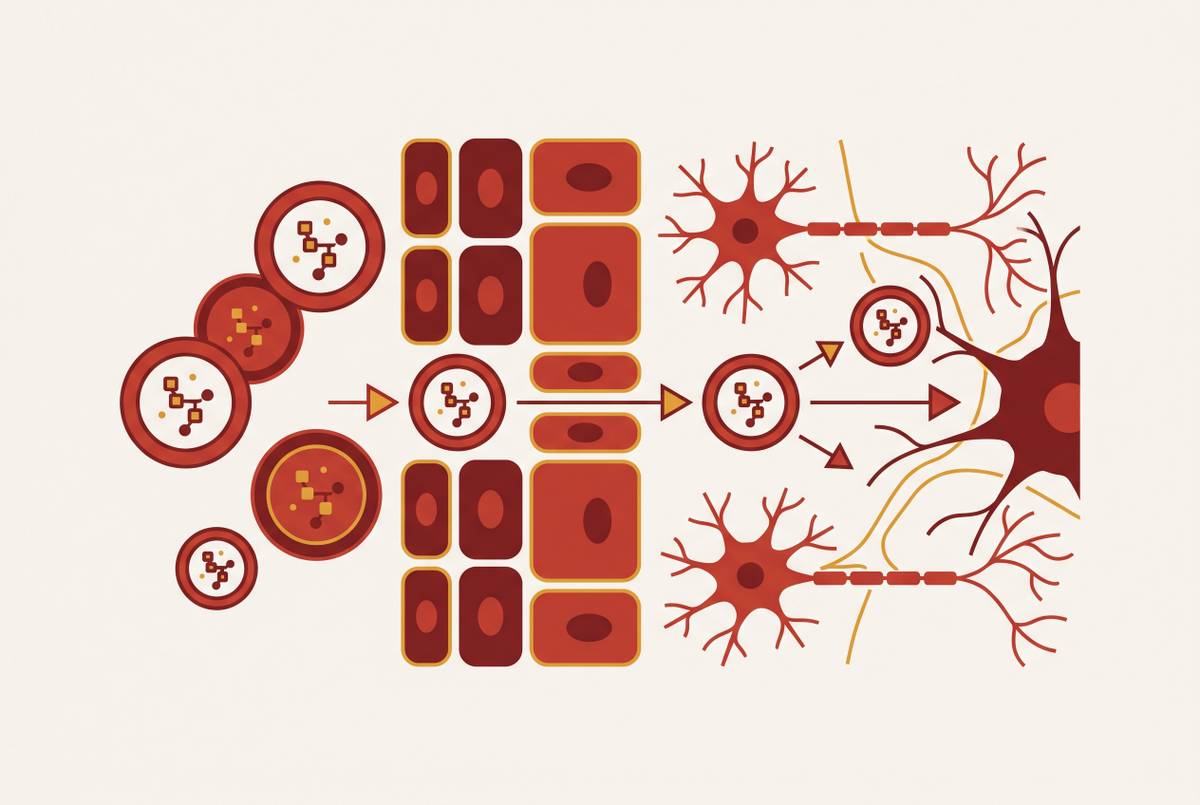
Nanoparticle Size and Zeta Potential Effects on in Vivo Behavior
Tuning particle size and charge unlocks direct brain delivery through nasal routes.
Nanoparticle nose-to-brain delivery for CNS peptide indications depends on tuning size and zeta potential for mucosal transport, protection from degradation, and brain access through olfactory and trigeminal pathways. These routes can bypass the blood-brain barrier. Size and charge help control delivery, but predicting it also means taking account of surface coatings, biological fluids, and the differences between rodent and human nasal anatomy.
Why size and charge are the primary controls on what a nanoparticle does in the body
Conventional pharmacokinetics begins with the drug molecule, while nanoparticle pharmacokinetics must also account for the particle that delivers it. The carrier has its own limits on absorption, distribution, metabolism, and excretion. Its properties are part of the delivery mechanism. Hydrodynamic diameter, surface charge as characterized by zeta potential, hydrophobicity, and delivery kinetics influence how the formulation interacts with living tissue. A drug’s biological activity alone cannot explain where its carrier goes or how easily cells take it up.
Size influences circulation time, targeting, and cellular uptake, while charge affects targeting and the interaction between particles and cell surfaces. These parameters are tunable. The chosen size and charge must help the particle reach the intended organ through the chosen route as well as make a suspension that is easy to use.
How particle size sets the rules for circulation, tissue access, and clearance
Particle diameter determines which barriers a nanoparticle can cross and which clearance mechanisms can remove it. Smaller is not automatically better for delivery. Although reducing diameter can improve access through some barriers, excessively small particles risk rapid renal elimination. The useful size window consequently has a lower boundary as well as an upper one. A formulation that gains tissue access but disappears too quickly may not provide the intended exposure.
For access across the blood-brain barrier, sub-200 nm particles are generally a better starting point, and sub-100 nm particles are especially relevant to uptake by brain endothelial cells. Size also influences which endocytic pathways cells engage, so choosing a diameter is partly a choice about cellular entry. Cylindrical or needle-like particles may facilitate greater uptake than spherical particles, making shape a secondary variable that interacts with size.
The practical consequence extends beyond brain delivery. A diameter selected to improve cellular entry may create a different circulation or clearance profile from one selected to prolong exposure. The target organ determines which effects the formulation must prioritize.
What zeta potential controls and where the ±30 mV threshold comes from
Zeta potential has two distinct roles in formulation, and the distinction prevents a common conceptual error. In suspension, it indicates the electrostatic repulsion that helps keep particles apart. In biological tissue, it helps explain interactions with charged surfaces. A value favorable for the first role does not necessarily serve the second.
The familiar ±30 mV threshold is a benchmark for colloidal stability. Particles with an absolute zeta potential of at least 30 mV are considered strongly charged and can be efficiently resuspended because of strong inter-particle electrostatic repulsion. The benchmark applies to both positive and negative values. It is not a biological performance threshold or a universal target for drug delivery.
Positively charged particles are more readily absorbed by negatively charged cell membranes, but stronger attachment is not always the desired outcome. A neutral to slightly negative charge can reduce nonspecific endothelial binding and help particles pass through the blood-brain barrier. Choosing a charge means balancing suspension stability with how particles behave in the body along the chosen route.
Even that balance depends on what the measurement represents. High-resolution characterization using tunable resistive pulse sensing illustrates how charge heterogeneity can be hidden by a bulk average. A reported zeta potential may conceal subpopulations with different biological behavior. Values from the literature need to be used with care to predict uptake or barrier transport.
Machine-learning evidence that size and charge are the strongest predictors of where a particle ends up
Wu et al. (2025) in ACS Nano integrated physiologically based pharmacokinetic modeling, quantitative structure-activity relationship principles, and multivariate linear regression to predict biodistribution from physicochemical descriptors. The PBPK-QSAR framework achieved strong predictive accuracy for kinetic indicators. Its strongest predictors were zeta potential, size, and coating. Core material and shape had lesser impacts, giving data-driven support to the mechanistic emphasis on diameter and surface properties.
Wu and colleagues used biodistribution data from healthy mice and focused on nondissolvable nanoparticles. Those boundaries limit extrapolation to other formulations and settings. The study also identified limitations in predicting concentration-time curves for certain particles and called for expanded datasets and nonlinear modeling.
As early design support, a descriptor-based model can help prioritize formulations before costly in vivo experiments, while leaving route-specific transport and biological uncertainty open to testing. Its value is not that it replaces mechanism. Rather, it shows that the parameters implicated by mechanistic reasoning also explain meaningful differences in observed organ accumulation.
Why the protein corona complicates the picture without invalidating it
The strongest challenge to parameter-based design is that a nanoparticle does not retain a fixed identity in biological fluids. Plasma proteins adsorb onto its surface and form a dynamic protein corona that changes its apparent size and charge. Consequently, measurements before exposure may describe a different object from the one interacting with tissue.
The reported average increase in complex size is roughly half, with an estimated corona thickness of 15–18 nm. A particle designed at 60 nm may therefore behave functionally as a 90 nm complex in circulation. Such a shift can move it beyond an intended size window. As the corona forms, it also changes zeta potential, which Wu and colleagues name as a limit of their model.
Yet this changing identity is not only an obstacle. Protein corona analysis has identified afamin, apolipoprotein E, and basigin as proteins that can facilitate blood-brain barrier penetration. That finding opens up the choice of materials and surface chemistries that attract useful proteins as well as discourage adsorption. PEGylation and surface coatings are tools for managing corona composition and anticipating changes in effective size and charge. Corona engineering is still being studied, however, and has yet to make brain delivery predictable.
How the nose-to-brain route changes the design problem for size and charge
Intranasal delivery changes the barrier that a formulation must negotiate. Drugs can reach the brain through olfactory and trigeminal pathways, bypassing the blood-brain barrier that constrains systemic delivery. The guidance to use Sub-200 nm and, ideally for endocytosis, sub-100 nm sizes still applies to nasal nanocarriers, where it helps with mucosal transport and pathway-specific delivery in place of blood-brain barrier crossing.
Nasal mucus adds a charged, viscoelastic barrier of its own. Positively charged, mucoadhesive particles can increase contact time, yet that adhesion may impede onward transport. Charge-neutral or muco-inert particles may move through mucus more efficiently, making the balance between retention and movement central to nasal formulation.
Nanocarriers can protect the active pharmaceutical ingredient from enzymatic degradation while facilitating mucosal transport. Cell-penetrating peptides offer a complementary strategy for hydrophilic, high-molecular-weight therapeutics. Upper nasal deposition, permeability-enhancing excipients, and nanocarrier design work together, so diameter or charge alone cannot determine delivery.
Translation introduces another constraint that formulation cannot erase. Rodents and humans differ in olfactory epithelium coverage, which limits what successful rodent transport establishes about human brain exposure. A favorable size-and-charge combination in a rodent model is therefore a candidate for translation.
Why GLP-1 peptides are a particularly demanding test case for intranasal nanoparticle design
GLP-1 peptides bring together three difficult delivery properties, being large, hydrophilic, and enzymatically labile. Nasal enzymes can degrade peptides rapidly, making protection of molecular integrity a prerequisite for useful transport. Encapsulation is the primary strategy described for this problem. Its size and charge must support residence and mucosal passage without sacrificing the peptide before it reaches the intended pathway.
The target biology gives this engineering challenge a clear rationale. GLP-1 receptors are expressed in regions involved in cognition, impulse control, reward, and appetite, including the hippocampus, cortex, and areas associated with addiction circuitry. The brain is therefore a plausible primary target. That rationale is distinct from proof that a brain-targeted formulation produces a neurological benefit.
A January 2025 Nature Medicine study of veterans linked the use of GLP-1 receptor agonist drugs to a lower risk of substance use disorders, neurocognitive disorders including Alzheimer's disease and dementia, and several other CNS conditions. A multi-cohort dataset published in July 2025 also found an association with reduced dementia incidence. These findings leave causation unestablished. A 2025 study, however, found that GLP-1 receptor agonists did not slow progression in patients with early-stage Alzheimer's disease, which suggests that preventing disease may differ from reversing it once it has begun.
Subcutaneous GLP-1 drugs must cross the blood-brain barrier to reach central targets, while nasal delivery could increase brain exposure in relation to systemic exposure. The approach aims to lower systemic exposure and avoid injections. That possible change in pharmacokinetics alone does not ensure fewer gastrointestinal side effects or clinical efficacy.
What preclinical evidence on intranasal GLP-1 delivery tells us about CNS selectivity
MetP Pharma announced results from a 2025 rat study in which its intranasal technology delivered peptide-based drugs rapidly to the brain while maintaining low systemic exposure. Brain-to-plasma ratios were consistently greater than 1. This supports preferential CNS delivery in that model. Brain exposure increased proportionally with dose, giving the reported result both a targeting signal and a dose-response relationship.
The rapid exposure profile is consistent with direct olfactory or trigeminal transport. Consistency is not the same as exclusive proof of mechanism. The findings support the platform’s preclinical direction, but they do not isolate how much of the observed selectivity came from size, charge, or other formulation features. Rodent results also cannot show how well the approach will work in humans.
Winterdahl et al. (2025) provided a separate line of evidence through a first-in-human PET study using labeled oxytocin. The study detected peptide uptake in human brain tissue between 25 and 45 minutes across the volunteers studied, although concentrations were low and variable. This was oxytocin evidence. It supports the possibility of human nose-to-brain peptide transport without demonstrating that a particular GLP-1 nanocarrier will achieve adequate or consistent CNS exposure.
Together, these findings identify the next uncertainty more precisely. Preferential GLP-1 delivery has preclinical support, while human peptide transport has been demonstrated with a different peptide. The anatomical translation gap remains open between those observations.
Turning size and charge from observed effects into deliberate design choices
The design implication is to work backward from the target organ and delivery route. For a hydrophilic peptide intended for nose-to-brain delivery, that means a sub-200 nm size window, ideally sub-100 nm for endocytosis, with charge managed for mucosal penetration and reduced nonspecific binding. Coating choice belongs in the same decision. These variables form a coupled system because a coating can change both effective charge and the biological layer that forms around the particle.
Once size is set, the choice of surface coating has a strong effect on the formulation. It can help recruit beneficial transporter proteins, repel opsonins, and tune the charge presented to biological surfaces. Prediction can then support formulation selection. The PBPK-QSAR framework successfully simulated biodistribution across 18 experiments, pointing toward fewer animal experiments and support for the nonanimal safety assessment frameworks that regulators increasingly require, while remaining bounded by its dataset and modeling limitations.
These design rules draw on decades of academic research and foundational nanoparticle intellectual property. These rules still need to be tested in human tissue before they can be used for human nasal delivery. Better in vitro human nasal models and more first-in-human studies are needed to close that gap. The unresolved test is whether a deliberately engineered particle retains useful transport behavior in human nasal biology and produces the intended CNS exposure.
Sources
- Data-Driven Prediction of Nanoparticle Biodistribution from Physicochemical Descriptors
- Effects of nanoparticle size, shape, and zeta potential on drug delivery - ScienceDirect
- Data-Driven Prediction of Nanoparticle Biodistribution from Physicochemical Descriptors - PMC
- High-Resolution Single Particle Zeta Potential Characterisation of Biological Nanoparticles using Tunable Resistive Pulse Sensing