Exosome and Extracellular Vesicle Platforms for CNS Peptide Delivery
Exosomes could deliver brain peptides by mimicking cells' natural transport.
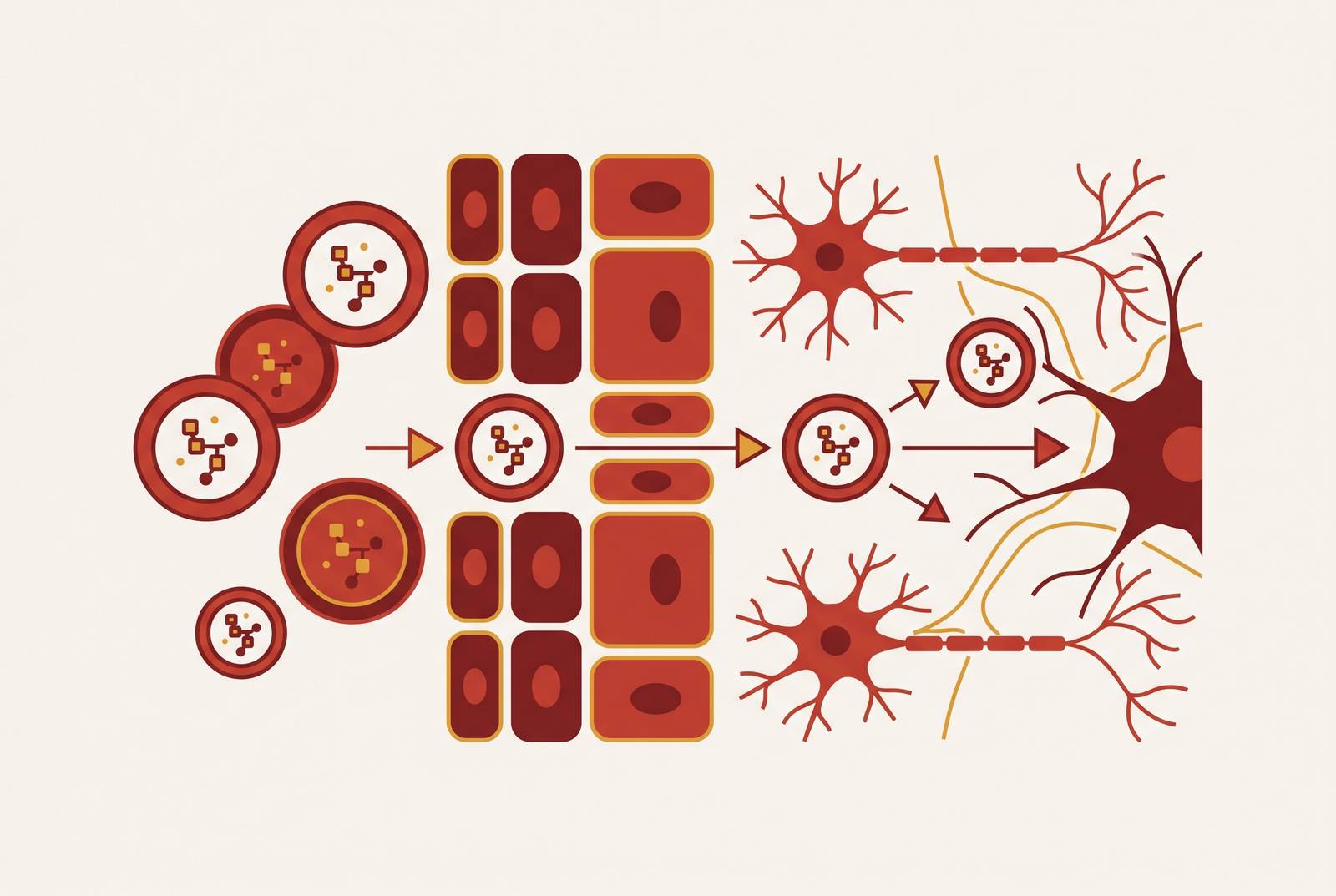
Exosome and extracellular vesicle platforms offer a biological approach to CNS peptide delivery, protecting fragile cargo while using natural pathways across the blood-brain barrier. Intranasal nanoparticle delivery offers a complementary route through nasal anatomy that bypasses the barrier. Their convergence is a coherent strategy for getting peptides into the brain, but therapeutic precision, manufacturing consistency, and clinical benefit remain to be established.
Why the blood-brain barrier defeats most drug delivery strategies, and what properties a carrier must have to overcome it
Tight junctions between brain microvascular endothelial cells close the spaces through which large or water-soluble molecules might otherwise pass. The basal membrane, pericytes, and astrocytes reinforce this physical boundary. A biochemical filter adds another obstacle, with transporter proteins including P-glycoprotein (P-gp) and breast cancer resistance protein (BCRP) expelling substances back into the bloodstream. Together, these defenses prevent nearly all macromolecular drugs, including peptides, from reaching brain parenchyma at therapeutic concentrations after peripheral delivery.
A carrier must therefore do more than keep a drug circulating. It must cross the barrier without triggering immune clearance, shield fragile cargo from enzymes, and deliver that cargo into the intended brain cells. Liposomes and polymeric nanoparticles have improved brain delivery, but limitations remain in targeting, long-term biocompatibility, and clearance. They are partial answers to a problem that requires transport, protection, and cellular recognition to work together.
What extracellular vesicles are, how they are classified, and why their biological origin gives them properties synthetic carriers cannot match
Extracellular vesicles, or EVs, are membrane-bound nanoparticles secreted by virtually all cell types. Their natural cargo includes DNA, RNA, proteins, lipids, and metabolites from the parent cell. Once regarded as cellular waste, they are now understood as vehicles for communication between cells. A vehicle that carries messages between cells already has features that must be built into an artificial drug carrier.
EV classification reflects differences in size and how the vesicles form. Exosomes are endosome-derived vesicles, approximately 30–150 nm, formed through inward budding in multivesicular bodies and released by exocytosis. Apoptotic bodies, by contrast, are released during programmed cell death and are larger and more heterogeneous. A vesicle’s origin has practical implications for its cargo and behavior.
Biological origin gives EVs intrinsic biocompatibility, low immunogenicity, and a documented capacity to traverse biological barriers. Their membranes also carry aspects of the parent cell’s functional identity. Some groups show parent-cell tropism, a tendency to home toward cell types like those that made them. Source-cell selection is therefore a design decision that can supply navigation properties synthetic carriers must approximate through surface engineering.
How EVs cross the BBB and why that crossing matters specifically for peptide cargo
EVs can use endogenous transcytosis pathways to pass through brain endothelial cells. Surface proteins inherited from their parent cells allow them to engage receptor-mediated transport, using a pathway the brain also employs for nutrient uptake. This lets the carrier get past tight junctions without forcing the barrier open. It also explains why the biological surface is functional machinery.
Serum and interstitial proteases can cleave a peptide before it reaches its target, so transport without protection may deliver little active cargo. An EV’s lipid bilayer shields encapsulated peptides from those enzymes during transit. Protection and transcytosis therefore address two distinct failure modes within the same carrier.
GLP-1 illustrates why both functions matter. Dipeptidyl peptidase-4 (DPP-4) rapidly degrades GLP-1 peptides in the periphery, while modifications including fatty acid conjugation and PEG addition can extend peptide half-lives. Even when peptides last longer in blood, they still face the BBB as a second filter. EV encapsulation offers a way to address both constraints, although the amount of functional peptide delivered still has to be established for each formulation. The broader cargo range, including proteins, miRNA, mRNA, DNA aptamers, and plasmid DNA, makes EVs a platform for multiple cargo types.
How EVs are engineered to improve targeting, loading, and brain-region specificity beyond their baseline biology
Reaching the brain is different from reaching a particular region, cell population, or intracellular compartment. EV engineering seeks to direct those later steps while preserving the membrane properties that made delivery possible.
Cargo loading exposes this trade-off clearly. Endogenous loading engineers producer cells to package therapeutic molecules, favoring functional integrity but offering less direct control over cargo quantity. Exogenous loading introduces cargo after isolation through methods including electroporation, sonication, co-incubation, and click chemistry. These methods offer flexibility, but they can damage cargo or disrupt membrane integrity. Loading efficiency must therefore be judged along with the state of the vesicle after loading.
Hybrid systems pair EV membranes with synthetic nanoparticle cores so they can have both the properties of a biological surface and the loading efficiency of a synthetic carrier. Work on these approaches first appeared in the literature in 2018–2019, with more prominent work in 2020–2022. Precision protein delivery and multimodal intracellular release systems extend the engineering task beyond uptake to release within particular compartments. The progression is from observing where EVs travel naturally to controlling what they carry, where they arrive, and where the payload becomes available.
How does intranasal nanoparticle delivery get peptides directly to the brain
Intranasal delivery changes the route rather than asking a carrier to cross the BBB from blood. Therapeutics absorbed through the olfactory epithelium can travel along olfactory nerve fibers toward the CNS, including the cerebral cortex and hippocampus. The trigeminal pathway and lymphatic/CSF transport provide additional conduits.
Putting EVs into a nasal spray combines that anatomical bypass with membrane-based cargo protection. The lipid bilayer can shield peptides from nasal enzymes just as it protects them from serum proteases. Yet a direct pathway does not mean unrestricted access, because the olfactory epithelium has limited surface area and nasal residence times are short. Mucociliary clearance can sweep material away before it enters the pathways to the brain. Nanoparticle systems designed for mucosal adhesion seek to extend that residence time and increase the fraction available for transport.
Lionbio is developing a nanoparticle-based nose-to-brain platform that applies this route logic to GLP-1 peptides. Its approach is complementary to vesicle-mediated delivery, while the biological behavior of intranasal nanoparticles must be established for each carrier. In both cases, nasal anatomy offers access that does not depend on a systemically administered peptide overcoming the BBB’s physical and biochemical filters. The carrier’s role then shifts toward protecting the peptide and helping it remain available at the site of absorption.
Why GLP-1 neurological indications are a compelling test case for EV-mediated CNS peptide delivery
GLP-1 is a strong test case for whether better delivery can make use of a neurological mechanism that already has support. GLP-1 receptors are expressed on neuronal populations, and CNS GLP-1 signaling influences synaptic plasticity, neuroinflammation, insulin signaling, and cellular energy management. In preclinical models of Alzheimer’s and Parkinson’s disease, receptor agonists reduce neuroinflammation, improve mitochondrial function, and enhance clearance of toxic proteins. Those effects have been accompanied by benefits in cognition and dopaminergic neuron survival.
Human evidence is more complicated. A pooled analysis combining three cardiovascular outcome trials of semaglutide and liraglutide with a Danish registry cohort found lower dementia rates among GLP-1 RA-treated patients in both data sources. Associations with reduced risks of seizures and addiction also support interest in neurological indications. But such signals do not establish that a peptide reaches brain tissue at a therapeutic concentration. Benefits could arise through improved vascular and metabolic health.
A 2025 meta-analysis of Alzheimer’s disease trials found no improvement in memory and cognition compared with placebo. A 2025 study likewise found that GLP-1s did not slow the disease in patients who already had Alzheimer’s disease. These findings are consistent with inadequate brain penetrance, but they do not prove that delivery is the limiting factor or that EVs would close the gap.
Brain-targeted delivery could help distinguish insufficient exposure from insufficient therapeutic effect at the target. A non-invasive route also addresses injection-related adherence barriers for cognitively impaired or elderly patients and people managing addiction. For intranasal platforms such as Lionbio’s, the intended contribution is protected delivery of GLP-1 toward CNS targets, with neurological treatment benefit still to be demonstrated.
What the first clinical-stage EV programs targeting CNS diseases reveal about where the platform stands
Registered intranasal EV trials show that this delivery concept has entered human investigation. NCT04388982 is an early-phase Alzheimer’s disease trial using allogeneic adipose MSC-derived EVs, with dates of 2020–2022. NCT06607900 is a Phase 1 trial using human umbilical cord MSC-derived EVs, with dates of 2025–2028. Its indications include Alzheimer’s disease, Parkinson’s disease, multiple system atrophy, Lewy body dementia, and frontotemporal dementia. Efficacy remains to be established in these registered trials.
Company programs reveal different engineering priorities. Evox Therapeutics in Oxford combines exosome biology, protein engineering, and proprietary manufacturing in its DeliverEX™ platform. The platform targets loading and functional delivery of RNA, gene-editing tools, and proteins across difficult biological barriers. Evox Therapeutics holds more than 100 granted patents globally covering core aspects of exosome engineering, loading, and targeting.
NurExone Biologic in Israel/Canada is developing ExoPTEN through its ExoTherapy platform. ExoPTEN carries siRNA designed to silence PTEN expression in damaged spinal cord neurons, and its first-in-human studies are expected in H2 2026–H1 2027. These programs illustrate that clinical entry and platform development are distinct stages. Source-cell choice adds another distinction, because human neural stem cell-derived EVs show increased neural homing and preclinical efficacy in stroke and traumatic brain injury, while their manufacturing capacity remains constrained.
The manufacturing and standardization barriers that currently limit EV platforms from routine clinical use
The strongest obstacle to routine EV therapy is turning promising biological material into a reproducible medicine. Laboratory production yields heterogeneous vesicle populations, often in low quantities. Vesicles in the same batch can differ in what they carry and how they work, so the amount in a batch tells only part of its quality. Without robust potency and batch-release assays, production volume alone cannot establish therapeutic consistency.
Isolation adds another source of variation. Differential ultracentrifugation, size-exclusion chromatography, precipitation, and emerging microfluidic approaches produce different balances of purity, yield, and cargo integrity. No single method has become the GMP standard. Nor are there harmonized potency assays or release criteria for EV therapeutics, leaving a regulatory gap for the FDA and EMA. Fit-for-purpose standards must connect product testing to the expectations applied to biologics and cell therapies.
NurExone formed its U.S. subsidiary Exo-Top to establish GMP-compliant manufacturing, while Evox Therapeutics incorporates proprietary manufacturing into its platform. These are not peripheral investments, because production methods help define what the therapeutic product actually is. Scalable production, quality control, long-term safety, and regulatory pathways remain active priorities. Addressing these industrial requirements is tractable in principle and requires more than the biological ability to cross a barrier.
What the convergence of EV biology, intranasal anatomy, and CNS peptide pharmacology implies for the next phase of delivery innovation
EVs provide biological transport and cargo protection, nasal anatomy provides routes around the BBB, and GLP-1 receptor biology provides a therapeutic rationale. Each supports the next experiment, but none alone establishes effective peptide exposure in the intended brain cells. Crossing a barrier, bypassing it, and producing clinical benefit are different claims.
Aruna Bio’s early clinical milestone for AB126 provides evidence of safety and tolerability in humans, but it does not establish class-wide safety or peptide efficacy. Likewise, the registered intranasal EV trials begin the clinical argument. The next phase includes earlier intervention studies with brain-penetrant formulations, biomarker-guided patient selection, and parallel investment in GMP-scalable manufacturing.
Synthetic platforms have a manufacturing maturity advantage, while EVs offer natural biocompatibility and tropism that synthetic surfaces seek to approximate. Their shared objective is non-invasive delivery that achieves therapeutic peptide concentrations in brain tissue. That objective defines an active frontier with concrete programs and testable mechanisms.
Sources
- Extracellular vesicles as drug and gene delivery vehicles in central nervous system diseases - Biomaterials Science (RSC Publishing) DOI:10.1039/D4BM01394H
- Extracellular vesicles as drug and gene delivery vehicles in central nervous system diseases - PMC
- Exosome-based therapeutics: Advancing drug delivery for neurodegenerative diseases - ScienceDirect
- Engineered exosomes as precision tools for brain-targeted drug delivery and treatment of central nervous system diseases - ScienceDirect
- Exosomes as CNS Drug Delivery Tools and Their Applications
- Intranasal Drug Delivery Technology in the Treatment of Central Nervous System Diseases: Challenges, Advances, and Future Research Directions - PMC
- Non-Invasive Strategies for Nose-to-Brain Drug Delivery