Receptor-Mediated Transcytosis Across the Blood-Brain Barrier
Smart receptor-binding tricks unlock the brain's hidden import doors.
Late-nineteenth-century dye experiments gave pharmacology one of its most durable images: inject a dye into the bloodstream and watch it stain nearly every organ in the body, except the brain, which stayed untouched. That selective refusal is the entire subject of this article, and it is still the central obstacle in CNS drug development more than a century later. The blood-brain barrier is not a wall in any simple sense but a layered, actively maintained system, and its architecture is why conventional drug design keeps failing at the brain rather than at the intended target. Brain capillary endothelial cells are sealed by tight junctions, and on top of that mechanical seal sit active efflux transporters, P-glycoprotein and BCRP among them, stationed on the luminal surface specifically to grab molecules that have already diffused into the cell and throw them back out before diffusion can become delivery.
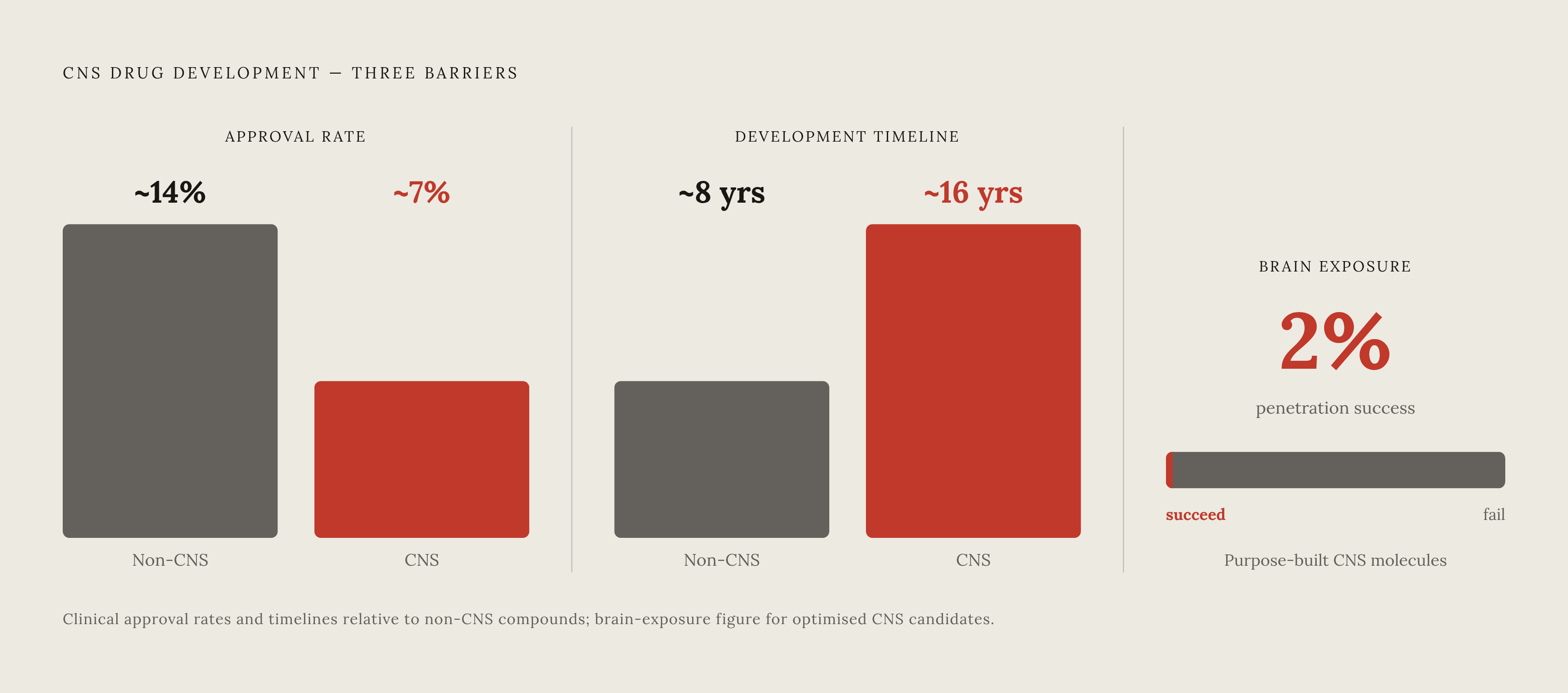
The consequence for drug chemistry is severe and quantifiable. Standard oral bioavailability rules are not strict enough for the brain: CNS penetration demands lower molecular weight, fewer hydrogen-bond donors, reduced polar surface area, and a LogP near 2, and even compounds engineered to hit every one of those targets succeed at brain exposure only about 2% of the time. Large-molecule biologics face a harder ceiling still. Antibodies, enzymes, and therapeutic peptides cannot cross by passive diffusion at all, because a monoclonal antibody sits orders of magnitude above the molecular-weight limit the barrier allows, and that single fact is why the field spent decades treating the BBB as an absolute wall for anything built at that scale.
The economic toll of that wall is just as concrete as the biology behind it. CNS drug candidates clear clinical approval at roughly half the rate of non-CNS drugs, their development timelines run nearly twice as long, and Alzheimer's research alone absorbed tens of billions of dollars over a decade with a failure rate that approached totality. None of that happened because researchers picked the wrong targets. It happened because almost nothing they built could physically reach the targets they had already identified. The question that follows is whether the barrier is truly as absolute as the dye experiment suggested, or whether it has doors built into it that the field only later learned to find.
Receptor-mediated transcytosis as the BBB's own import system
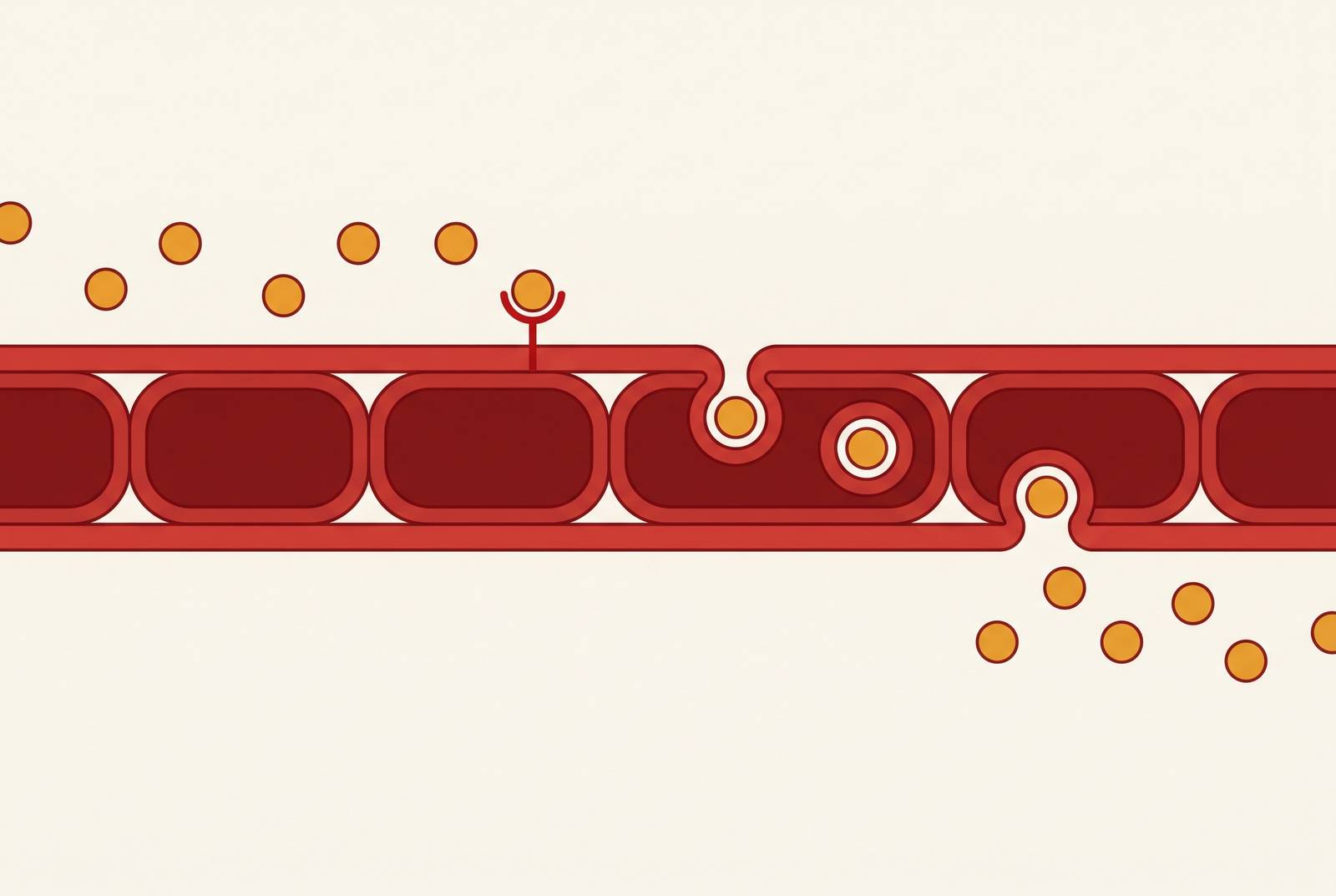
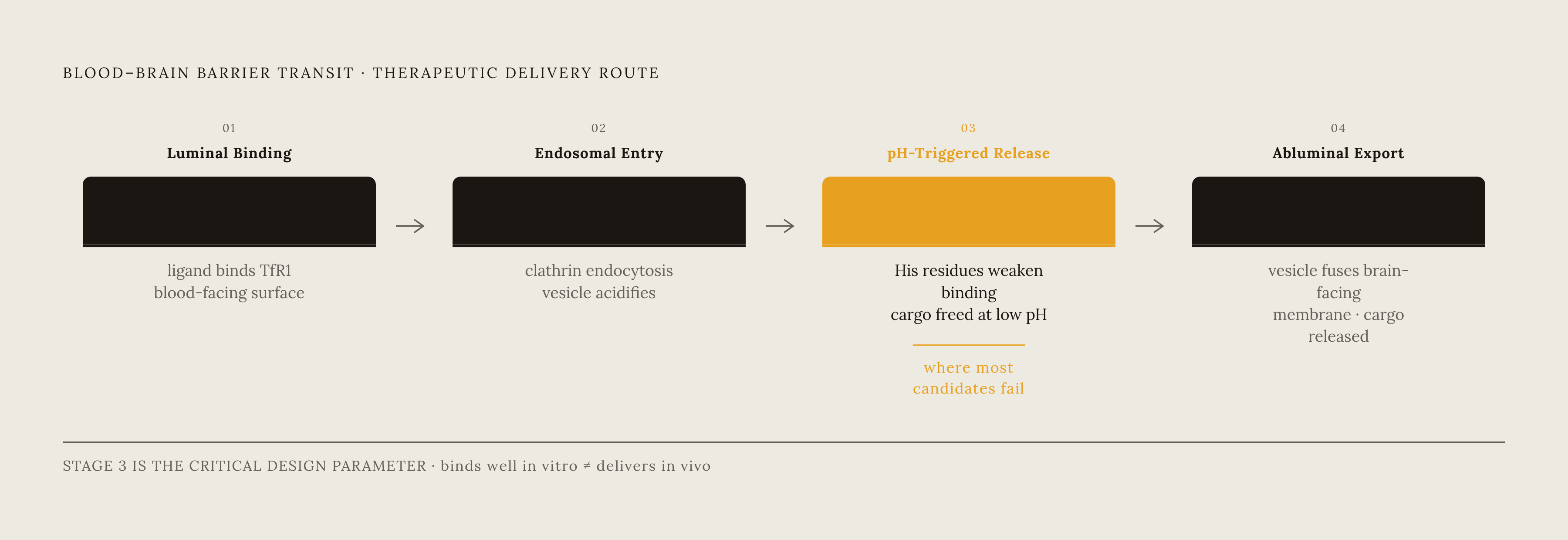
The brain is not a sealed vault. It needs iron, insulin, and a range of other molecules from the blood to function, and it has to get them in by some route even with tight junctions closing off the gaps between cells. The process has a fixed order. A ligand binds its receptor on the blood-facing, or luminal, surface of a brain endothelial cell; that binding event triggers internalization into a vesicle; the vesicle is trafficked across the interior of the cell; and at the far, brain-facing abluminal membrane, the vesicle fuses and releases its cargo into the tissue beyond.
The transferrin receptor system makes this concrete. Iron-loaded transferrin binds TfR1 on the luminal surface, the complex is pulled inside through clathrin-mediated endocytosis, the iron detaches once the vesicle's interior turns acidic, and the receptor recycles back to the surface, empty-handed, ready to repeat the cycle. That cycle runs constantly in a healthy brain, delivering iron the organ cannot make itself. TfR1 is expressed densely on brain endothelial cells, it already runs a high-volume transcytosis cycle for its native cargo, and its mechanism has been characterized in enough detail to engineer against, which explains why this particular receptor became the field's favorite entry point. Researchers scanning for other usable doors have found several, each with its own binding behavior and trafficking quirks, but three have become the most clinically actionable: the transferrin receptor, the insulin receptor, and the neonatal Fc receptor.
What these three share matters more than their differences. Each proves that the barrier is selectively permeable rather than impermeable, and each proves that the permeability is receptor-gated, meaning cargo must look enough like a natural ligand to be recognized and admitted. That insight reframes the entire delivery problem. Instead of asking how to force a molecule through a sealed barrier, the question becomes how to make a molecule convincing enough, at the molecular level, to be mistaken for something the brain already imports. But recognition at the luminal surface is only the first step, and a therapeutic that binds its receptor well can still fail at the steps that follow, since beyond TfR1 the transferrin receptor, insulin receptor, and neonatal Fc receptor are the three most clinically actionable targets, each with distinct mechanisms of transcytosis. That gap between binding and delivery is where most engineering programs have lost ground, and it is the subject of the next section.
Affinity tuning at endosomal pH, the design parameter most engineering efforts get wrong
Binding to a receptor at the luminal surface is a necessary condition for transcytosis, but it is nowhere near sufficient. Cargo that grips its receptor too tightly once inside the acidic endosome gets trapped there rather than released into the parenchyma, so affinity has to be tuned for two opposite jobs: strong binding on the way in, and release on the way out. An engineered ligand that ignores this switch, holding its receptor at the same affinity regardless of pH, never gets the release signal. It stays bound, and the whole complex gets sorted back toward the luminal surface or diverted into a lysosome rather than reaching the abluminal membrane where delivery actually happens.
A specific engineering result makes the fix concrete. Mouse TfR-binding nanobodies built with histidine residues designed to weaken binding specifically at acidic pH showed markedly enhanced transcytosis, and when administered peripherally they produced a measurable brain-level effect, neurotensin-induced hypothermia, confirming that the cargo was not just crossing the barrier but doing something pharmacologically real once it arrived. Histidine is the engineering trick that makes this work: its side chain picks up a proton at endosomal pH, weakening the receptor interaction at precisely the moment release needs to happen, then loses that proton again once the complex nears the neutral pH of the abluminal side, restoring strong binding exactly where it is needed again. But this is the detail that separates a molecule that binds TfR1 well in a test tube from one that actually delivers its payload, and that distinction explains a good deal of why early RMT candidates underperformed even when their receptor affinity looked excellent on paper.
A second, smaller complication compounds the challenge of competing for receptor access. Engineered ligands are not the only thing trying to use TfR1. They have to compete with the brain's own supply of endogenous transferrin for the same receptor, and they have to avoid saturating the receptor pool altogether, since saturation slows the whole transcytosis cycle down rather than speeding a single molecule's delivery. Put together, these constraints reveal that RMT engineering is a question of pharmacokinetics conducted inside a single cell: a therapeutic candidate's entire intracellular itinerary has to be designed on purpose. Denali Therapeutics was built on the premise that CNS drug failure is a delivery problem rather than a target problem, and AVLAYAH's approval on March 25, 2026 validated that founding thesis with a regulatory first: the first biologic engineered to cross the BBB via RMT.
Denali's Transport Vehicle platform and the first approved brain-crossing biologic
On March 25, 2026, AVLAYAH became the first biologic engineered to cross the blood-brain barrier via receptor-mediated transcytosis to receive FDA approval, a regulatory first that validated the founding premise behind Denali Therapeutics: that the obstacle standing between CNS targets and CNS treatments was delivery. AVLAYAH, known generically as tividenofusp alfa-eknm, is an enzyme replacement therapy approved for the neurologic manifestations of Hunter syndrome in pediatric patients, and the clinical evidence behind it came from a Phase 1/2 study published in the New England Journal of Medicine in January 2026 that enrolled 47 male participants ranging in age from 3 months to 13 years.
The mechanism behind AVLAYAH is the applied version of the pH-affinity engineering described in the previous section. Denali's Transport Vehicle is an engineered antibody Fc fragment built to bind TfR1 on the luminal surface of brain endothelial cells, triggering the same receptor-ligand internalization sequence that governs the native iron-transferrin cycle, and in doing so it commandeers the iron-import pathway to carry a therapeutic enzyme far too large to cross on its own. That a therapy built on this mechanism cleared both the clinical and regulatory bar is the clearest evidence available that tuning a therapeutic's receptor affinity can be done reliably at scale, not just in a mouse nanobody experiment.
Denali's pipeline suggests the platform generalizes rather than working only for one disease. A Phase study of DNL593, a Protein TransportVehicle™ for progranulin replacement in FTD-GRN, has completed enrollment, with results now expected in 2027, and in March 2026 the first patient was dosed in an early Phase study of DNL628, an Alzheimer's therapy using the Oligonucleotide TransportVehicle™ designed to reduce tau by targeting the MAPT gene. Denali is not alone in building on this logic. Roche's Brain Shuttle technology fuses a monovalent anti-TfR binding arm to therapeutic antibodies and is advancing through clinical development for CNS targets of its own, representing a parallel industry effort grounded in the same RMT mechanics.
The market response to AVLAYAH's approval has been just as telling as the clinical data. Denali sold its Rare Pediatric Disease Priority Review Voucher for hundreds of millions of dollars in June 2026, a transaction that illustrates the kind of financial infrastructure now available to CNS delivery platforms once they clear regulatory validation. Six days after the approval, a major pharmaceutical company committed billions of dollars to acquire Centessa Pharmaceuticals for a CNS asset, and the proximity of those two events in the same week marked a visible shift in how the industry priced BBB-crossing technology. That shift had already been building. CNS mergers and acquisitions reached tens of billions of dollars in 2025, surpassing oncology for the first time, signaling that the field's perception of BBB tractability had changed before the approval itself.
Cargo distribution after crossing the barrier
Crossing the endothelium is not the finish line. A molecule that reaches the abluminal membrane and gets released into the brain still has to find its target cell, survive the trip there, and remain active once it arrives, and each of those steps is a distinct problem from transcytosis efficiency itself. Cargo can clear the barrier successfully and still fail the patient: it can be re-absorbed by astrocytes or microglia before reaching neurons, or it can degrade in the extracellular matrix before ever making contact with a target cell. What if the barrier were not the hardest part of the journey after all?
Brain parenchyma is a crowded, structured environment rather than an open fluid space. Matrix proteins, glial cell processes, and perivascular drainage currents can trap a molecule near the vessel wall, dilute its concentration before it travels any distance, or sweep it away from the tissue it was meant to reach. Size and surface chemistry govern how far released cargo actually gets: small, neutral molecules diffuse comfortably through this terrain, while large, charged, or aggregation-prone molecules tend to stall close to the capillary they just emerged from.
Nanoparticle carriers add a further wrinkle to this picture. Surface properties engineered to optimize a nanoparticle's stability and release profile inside brain tissue can improve one stage of the journey while working against another, since the same modifications that help a particle cross the endothelium efficiently are not necessarily the ones that help it diffuse freely once released. Designing for the full route, from luminal binding through endosomal release and abluminal export to parenchymal distribution, means treating BBB transit as a multi-stage pharmacokinetic problem with its own distinct bottleneck at each stage, rather than compressing the entire journey into a single permeability number. That reframing does not diminish what RMT has already achieved. It sharpens the next engineering question: how do carrier platforms address transcytosis and parenchymal distribution as two separate design targets rather than one.
Nanoparticle and antibody engineering extending RMT to new cargos
The most lasting advance to come out of RMT research is not a single approved molecule but a class of modular carrier platforms, nanoparticles, bispecific antibodies, and engineered vesicles, that separate the function of finding the brain from the function of carrying a payload. That separation is what lets the same delivery machinery carry enzymes, oligonucleotides, peptides, and gene-editing tools without being redesigned from scratch for each one.
Antibody engineering for RMT has converged on a bispecific architecture: one arm of the antibody engages an RMT receptor such as TfR1, InsR, or FcRn, while the second arm carries or engages the actual therapeutic target, and both the Brain Shuttle and Transport Vehicle platforms are clinical expressions of exactly this design principle. The choice to make the TfR-binding arm monovalent rather than bivalent is deliberate rather than incidental. Bivalent binding clamps the receptor complex too rigidly and saturates the receptor pool, and that rigidity impairs transcytosis rather than helping it, which is the specific reason Roche's Brain Shuttle technology uses a monovalent design.
Nanoparticle platforms extend the same logic to a different chassis. Polymeric nanoparticles, PLGA-based formulations in particular, along with lipid nanoparticles and extracellular vesicles, can be surface-functionalized with RMT-targeting ligands, converting what starts as a passive carrier into an active BBB-crossing vehicle while still encapsulating a therapeutic payload that could never have crossed the barrier unassisted. Each surface modification parameter on these carriers does a different job along the route: ligand density affects how efficiently the particle binds at the luminal surface, PEGylation and charge shape how the particle moves through the endosome and the extracellular matrix once released, and particle size constrains how far it can ultimately diffuse through brain tissue.
Read against the earlier sections, this is the shape the field has settled into. What has changed is the precision with which researchers can now describe, and build toward, each individual step in the sequence, from luminal recognition through endosomal release to abluminal export and parenchymal distribution, so that a therapeutic can be engineered for the entire route rather than judged on a single permeability measurement. AVLAYAH's approval shows that route working end to end in a patient population that needed it. The modular platforms now under development suggest that route is becoming reusable rather than bespoke, which is the quieter but perhaps more consequential part of the story.
Sources
- Advanced Drug Delivery Strategies for Overcoming Biological Barriers: Tumor Microenvironment and Blood–Brain Barrier - PMC
- Antibody Engineering for Receptor-Mediated Transcytosis Across the Blood–Brain Barrier
- 98% of Drugs Cannot Cross the Blood Brain Barrier. Denali Just Got One Through.
- Targeting Transferrin Receptor 1 for Enhancing Drug Delivery Through the Blood–Brain Barrier for Alzheimer’s Disease
- The New England Journal of Medicine Publishes Phase 1/2 Study of Denali Therapeutics’ Tividenofusp Alfa (DNL310) for Hunter Syndrome (MPS II)
- Denali Therapeutics Wins FDA Accelerated Approval for AVLAYAH in Hunter Syndrome, Eyes Launch Boost