Nanoparticle Encapsulation as a Peptide Stability Strategy
Nanoparticles shield peptides from degradation and control when they reach their targets.

Peptides are, molecule for molecule, some of the most precise drugs available. They hit receptors that small molecules can't touch and do it with a specificity that borders on elegant. But that same precision comes wrapped in fragility: peptides get chewed up by enzymes, cleared by the kidneys, and blocked by nearly every membrane barrier the body has to offer. Nanoparticle encapsulation exists to solve exactly that mismatch, and this piece walks through why it's less an add-on technology than the design brief peptide drugs have always needed.
Consider the numbers involved. A peptide that binds its target with subnanomolar affinity in a test tube can lose almost all of that potency by the time it survives a real dosing route, and many don't survive the route. That gap between what a molecule can do and what it actually does inside a body is the whole reason delivery science exists. Work published by researchers in a peer-reviewed journal (2026) frames the core peptide drug problems directly: peptides suffer from poor stability, face barriers to intracellular access, and present challenges for combination delivery. None of those are failures of the peptide itself. They're failures of the vehicle carrying it, and that distinction matters, because it points toward an engineering fix rather than a molecular dead end.
The gauntlet a peptide must survive from administration to site of action
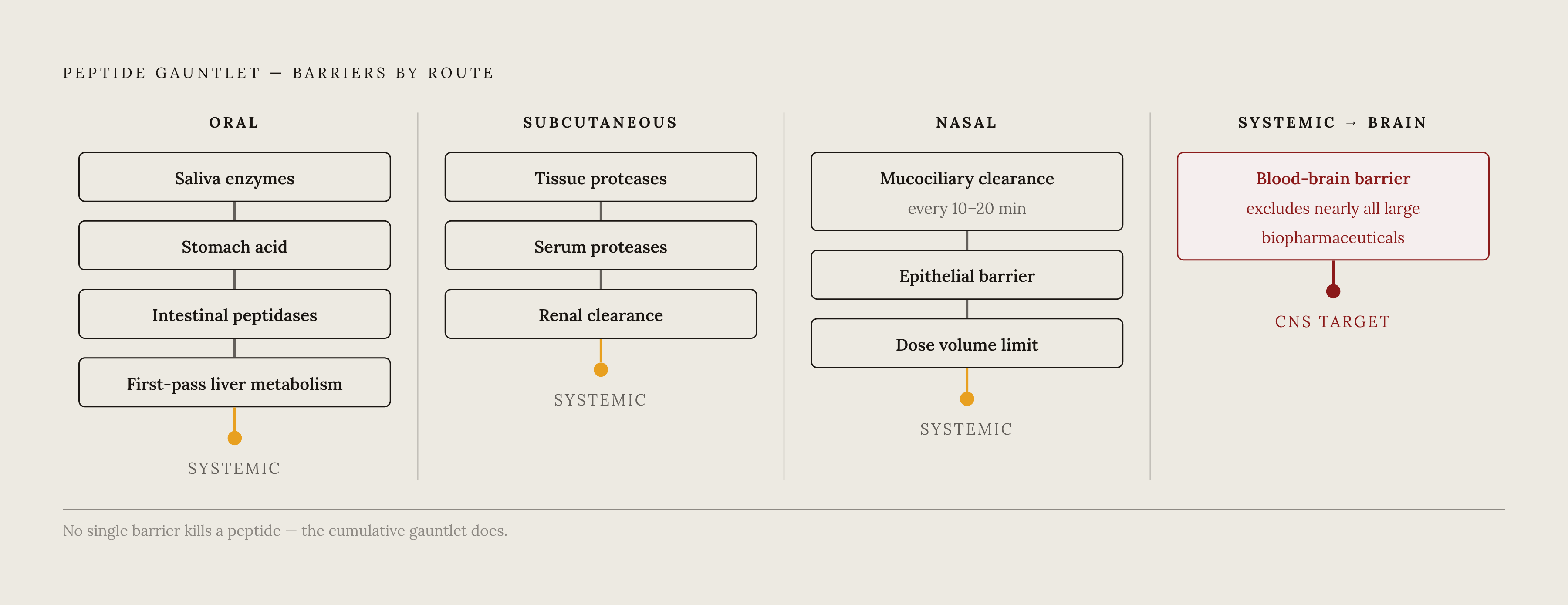
Every route into the body throws a different set of obstacles at a peptide, and none of them are forgiving.
Swallow one, and it meets saliva enzymes, then stomach acid, then a dense population of intestinal peptidases, then the liver's first-pass metabolism before it ever reaches the bloodstream. Most native peptides don't survive that gauntlet in meaningful concentrations. Oral peptide drugs remain rare, and the ones that exist need heavy formulation tricks just to function.
Injection under the skin skips the gut entirely, but it isn't a clean escape. Tissue proteases sit right at the injection site, waiting, and once the peptide reaches circulation, serum proteases pick up where they left off. Short half-lives are the practical result, and short half-lives mean frequent dosing, which is its own adherence problem (a point that becomes central later in this piece when GLP-1 drugs come up).
The nasal route offers a genuinely different opportunity, and also a genuinely different set of headaches. Mucociliary clearance renews the mucus layer roughly every ten to twenty minutes, which is a brutally short window for any drug to get absorbed. The nasal epithelium itself is both a physical wall and a biochemical one, and nostrils only accept small volumes per dose, which forces formulators toward concentrated, potent preparations rather than dilute ones.
Then there's the blood-brain barrier, which doesn't care what route got a peptide into the bloodstream. It excludes nearly all large biopharmaceuticals regardless of path, so systemic delivery, on its own, is largely a non-starter for peptides meant to act inside the brain. Adding all this up shows why so much of a given peptide dose never reaches its target: it's degraded, cleared, or blocked before it gets the chance. Nanoparticle encapsulation is the response to that entire sequence, addressed barrier by barrier rather than solved in one clever step.
What nanoparticle encapsulation does to protect a peptide
At its core, encapsulation is about hiding the peptide. A polymer shell or lipid shell physically separates the peptide from the enzymes and pH extremes that would otherwise degrade it, and that separation holds until something, deliberately, triggers release.
That protection breaks down into a few concrete mechanisms. Enzymatic shielding keeps proteases from reaching the peptide backbone. pH buffering, built into the choice of carrier material, resists the acidic environments that would otherwise unfold or cleave the molecule. Surface modification, PEGylation being the most established example, reduces opsonization (the tagging of a particle for immune destruction) and stretches out how long the particle circulates before clearance.
Research on polymeric nanoparticles describes them doing three things at once for peptide drugs: raising bioavailability, allowing controlled and sustained release, and improving how well cells actually take the peptide up. That middle point, controlled release, deserves attention on its own, because it reframes what the nanoparticle is actually for. It's a shield in transit, but it's also more than that. It's a timing mechanism, one that determines when and where the peptide gets released so it doesn't fire off its activity too early or in the wrong tissue.
Some systems push this further into what's called stimuli-responsive design. Researchers writing in another peer-reviewed journal (2026) describe nanocarriers engineered to respond to specific physiological triggers so that release happens in step with the biology around it rather than on a fixed clock. Passive formulations can't do that. The peptide isn't just protected in that scenario; it's scheduled, released at a location and a moment chosen by the carrier's chemistry rather than by chance.
How peptides get into nanoparticles
Adnan and colleagues (2026) group peptide loading into three broad strategies, and each one handles incorporation differently, with a different cost attached.
Physical encapsulation covers methods like emulsion techniques, solvent evaporation, spray drying, and ionic gelation. The appeal here is straightforward: the peptide's native structure stays intact, no chemical bonds are added or broken, and it's the gentlest of the three approaches. The tradeoff appears in consistency. Encapsulation efficiency can swing from batch to batch, and if the carrier degrades unevenly, the peptide inside can end up exposed before it should be.
Chemical conjugation takes a more forceful route: methods like EDC/NHS coupling, thiol-maleimide chemistry, sulfo-SMCC linkers, or copper-catalyzed azide-alkyne cycloaddition (CuAAC) attach the peptide to the carrier with an actual covalent bond. That bond means better retention and a more predictable release event, since release now depends on breaking a specific, known linkage rather than waiting for the carrier to erode. But bonding a molecule to something changes its shape, at least locally, and that shape change can quietly reduce receptor affinity if the linker isn't designed with real care.
Self-assembly is the strategy that asks the least of external engineering and the most of the peptide's own chemistry. Peptides can organize themselves into hydrogels, micelles, nanotubes, or nanofibers, driven by hydrophobic interactions, electrostatic attraction, or hydrogen bonding, so the peptide is simultaneously the cargo and the building material. It's elegant on paper. In practice, these structures are sensitive to ionic strength, pH, and temperature, and getting the same self-assembled structure to form the same way at manufacturing scale, batch after batch, remains a real hurdle.
None of these three choices is separable from the rest of the formulation. Whichever strategy a team picks shapes the release kinetics, how active the peptide is once it's released, and which manufacturing path is even feasible from bench to clinic. Adnan and colleagues also point to newer developments in cyclic and stapled peptides, structural modifications that lock the peptide's shape in place, as a way of making the cargo itself tougher before it ever meets a nanoparticle shell. A more stable peptide going in only makes the loading strategy's job easier.
The nanocarrier landscape (which platforms are suited to which delivery challenges)
No single nanoparticle platform wins across the board, because the right answer always depends on the specific delivery problem in front of it.
Lipid nanoparticles (LNPs) are typically built from an ionizable lipid, helper phospholipids, cholesterol, and a PEGylated lipid. The ionizable lipid becomes protonated once it's inside the acidic environment of an endosome, and that protonation destabilizes the endosomal membrane just enough to let the cargo escape into the cytoplasm, which matters a great deal for any peptide that needs to act inside the cell rather than outside it. LNPs also carry something few other platforms can claim: a manufacturing and safety track record established at massive scale through the mRNA vaccines Comirnaty and Spikevax. That regulatory history is now being extended toward peptide and protein payloads.
Polymeric nanoparticles, with PLGA-based systems among the widely studied examples, offer biodegradable matrices whose degradation rate can be tuned. That tunability makes them useful for sustained, extended peptide exposure, whether local or systemic.
Liposomes bring a phospholipid bilayer with decades of established safety data behind them, and their surface can be modified to steer them toward specific tissue targets. Solid lipid nanoparticles (SLNs) rely on a solid lipid core for physical stability, a property relevant to routes that demand robust formulations. Dendrimers, with their branched polymer structure, support both high peptide loading and multiple types of surface chemistry at once.
One of the more unusual entries in this landscape comes from biology itself. Li and colleagues, writing in Small (2026), describe encapsulin protein cages, naturally occurring protein shells, that encapsulate cargo through cooperative interactions between the cage's ligands and the peptide cargo. The ligands promote electrostatic attraction and help the peptide extend into position, while the peptide itself widens the zone where structural units of the cage get recruited and helps prevent the whole assembly from getting kinetically trapped in a half-formed state. It's a system where the cargo and the container actively cooperate to build the final structure, rather than one simply being stuffed inside the other.
Hybrid and stimuli-responsive systems are the frontier of all this, combining features from lipid, polymer, and peptide-based platforms into single assemblies. These are the systems being explored hardest for CNS targeting and precise, on-demand release, and platform choice ultimately comes down to route of administration, the target tissue, required release timing, the peptide's own chemistry, and how much regulatory precedent already exists. Novelty for its own sake isn't the deciding factor.
Why the intranasal route changes the nanoparticle design requirements
The nose offers something genuinely rare: a direct anatomical path to the brain by way of the olfactory and trigeminal nerve networks, one that bypasses the blood-brain barrier entirely rather than trying to punch through it. That's a real opportunity. It also comes loaded with formulation constraints that make intranasal peptide delivery close to impossible without nanoparticle engineering behind it.
Start with volume. Only a small amount of liquid can go into a nostril per dose, so whatever formulation gets used has to be concentrated and potent, not dilute. Then there's mucociliary clearance, sweeping the mucus layer away on a timescale of minutes, fast enough that a conventionally formulated peptide often gets cleared before meaningful absorption even happens. The epithelium underneath adds a second layer of resistance, both physical and biochemical.
Permeation enhancers, chemicals that temporarily loosen the epithelial barrier to let more drug through, come with their own risk. Repeated exposure, especially in chronic dosing situations, can irritate the mucosa, impair ciliary function, or damage the epithelium. That's not a trivial side effect to manage if a drug is meant to be used daily or weekly over years.
Nanoparticles address each of these constraints in a fairly targeted way. Mucoadhesive coatings on the particle surface let it stick to the mucus layer, buying time against clearance rather than fighting it head-on. Small particle size helps the carrier slip through the mucus mesh and epithelial junctions. Encapsulation shields the peptide from nasal enzymes during the narrow transit window, and controlled release timed to the olfactory mucosa's absorption window means the drug is available exactly when the tissue can actually take it up.
There's already a concrete demonstration that this works for peptide hormones specifically. A PET imaging study using the radiotracer [68Ga]Ga-NOTA-insulin found that intranasally administered insulin was detectable in brain regions including the hippocampus, amygdala, and olfactory cortex over the post-dosing imaging period. And the regulatory path isn't hypothetical either: nasal glucagon (Baqsimi) is FDA-approved for emergency use, and intranasal diazepam and midazolam are approved for seizure management. Between the imaging data and the approved products, there's a working framework a regulatory agency already uses to evaluate nose-to-brain peptide delivery. That framework matters, because it means intranasal peptide delivery is a path with regulatory precedent.
GLP-1 peptides as a case study in why delivery innovation matters at the population level
GLP-1 receptor agonists have grown well past their original role in type 2 diabetes. They're now used for weight loss, cardiovascular risk reduction, fatty liver disease, sleep apnea, and kidney disease, with neurological applications emerging as well, a breadth of indication that makes this drug class about as close to foundational as pharmacology gets right now. The market for these drugs is already worth billions, and most analyst projections have that figure growing substantially over the next decade. Demand clearly isn't the constraint.
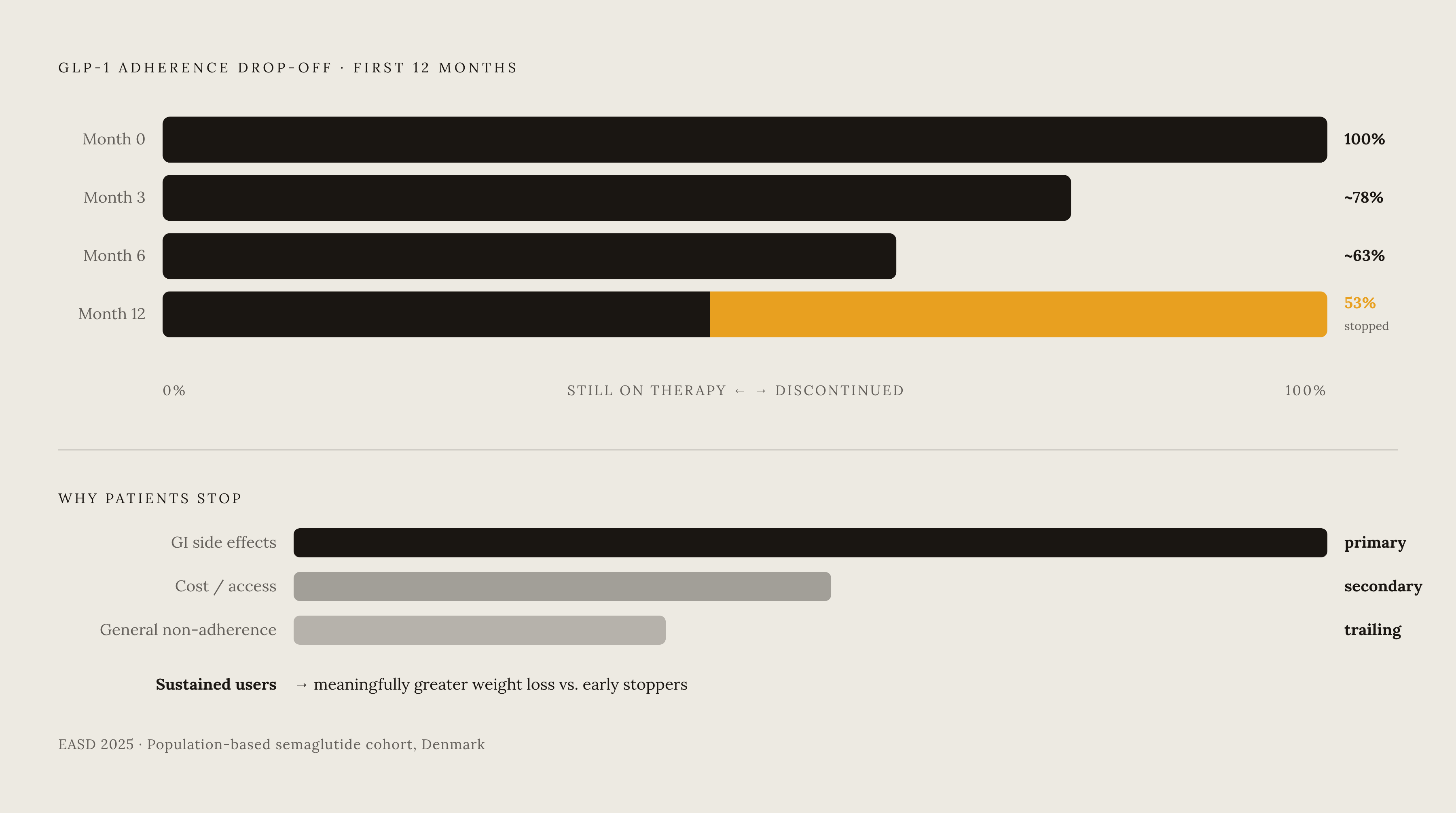
Adherence is. A large share of patients who start injectable GLP-1 therapy stop within the first year, and multiple datasets put one-year discontinuation among a majority of patients who don't have type 2 diabetes. A population-based study of semaglutide use in Denmark, presented at EASD 2025 in Vienna, found more than half of first-time users had stopped within a year. Gastrointestinal adverse effects, nausea most of all, drive a large portion of those discontinuations, with cost and general non-adherence trailing behind. Pooled safety data also show older patients discontinuing at higher rates than younger patients, and GI events are consistently the dominant reason.
What does quitting early actually cost a patient? Sustained users see meaningfully greater weight loss than those who stop partway through, so early discontinuation isn't a neutral outcome, it's a real therapeutic shortfall, one that appears in the outcomes data as clearly as any efficacy number does.
Some of that nausea likely traces back to the route of delivery itself. Subcutaneous injection puts GLP-1 into systemic circulation, where it activates peripheral GLP-1 receptors, including the ones involved in triggering vomiting, alongside the metabolic receptors the drug is actually meant to hit. A delivery approach that could route the drug more directly to the brain, bypassing that broad peripheral exposure, might in principle reduce that side effect without sacrificing the drug's central effects. That gap makes delivery science, not molecular redesign, the lever worth pulling here. The case for better delivery is a matter of practical consequence for patients. What GLP-1 biology is capable of exceeds what most patients on the current injectable paradigm actually experience.
The neurological frontier that injection-based delivery cannot reach as effectively
GLP-1 does more than regulate metabolism. Inside the brain, it acts as a neuroprotective signal, and preclinical research has linked GLP-1 receptor activation to reduced neuroinflammation, lower oxidative stress, less neuronal apoptosis, and reduced pathological protein aggregation, alongside improvements in glucose metabolism and mitochondrial function in neural tissue.
One detail stands out as a rationale for intervention: GLP-1 expression drops off in most brain regions after roughly the fifth decade of life. That decline lines up naturally with the biology of aging-related neurological disease, and it builds a real case for GLP-1 replacement in that population. Injectable, systemic delivery can't exploit that opportunity efficiently, because the blood-brain barrier caps how much of the peptide ever reaches the tissue where it would need to act.
Adjacent peptide research offers a signal worth watching. Intranasal insulin has been tested across multiple clinical trials in Alzheimer's disease, with some results pointing to favorable shifts in amyloid-beta biomarkers and improved verbal memory. A randomized controlled trial published in 2025 found that long-acting intranasal insulin significantly shortened hospital stay, alongside a reduction in median delirium duration that didn't reach statistical significance. Findings like these don't establish whether nose-to-brain peptide delivery will reshape neurological care. But they do establish, concretely, that peptide hormones delivered intranasally can reach the brain and produce measurable effects there, which is precisely the mechanism the rest of this piece has been building toward.
Sources
- Peptide‐Ligand Cooperative Interplay Drives Gold Nanoparticle Encapsulation by Protein Cages
- Therapeutic peptides and proteins: Status and developments in drug delivery - PMC
- Peptide-Based Nanocarriers for Targeted Drug Delivery: Recent Advances, Strategies, and Therapeutic Frontiers
- Advances in the Oral Delivery of Protein and Peptide Drugs - PMC
- Co-Encapsulation and Co-Delivery of Peptide Drugs via Polymeric Nanoparticles - PMC
- Frontiers | Navigating the complexity of oral peptide delivery: challenges and strategies to enhance oral bioavailability
- onlinelibrary.wiley.com