Nose-to-Brain Transport Mechanisms for Peptide Therapeutics
Nasal delivery bypasses the blood-brain barrier through direct neural pathways.
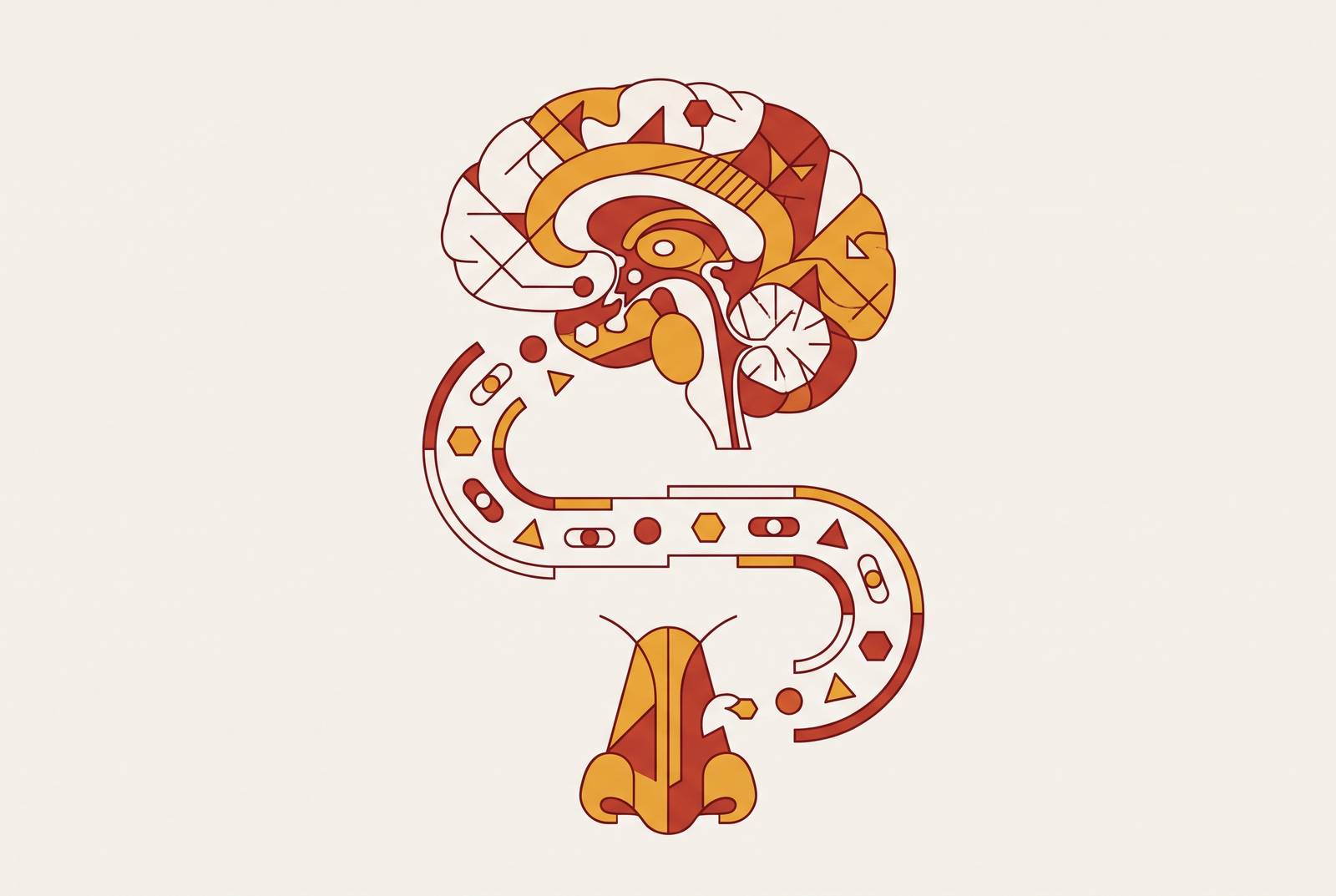
The blood-brain barrier blocks roughly 98% of small-molecule drugs and nearly all large biopharmaceuticals from reaching the central nervous system. That leaves peptide therapeutics in a rough spot: they're big, they carry water-loving charged groups, and they degrade fast in circulation, three properties that make them among the hardest molecule classes to get past that barrier. The nasal cavity offers a workaround that skips the bloodstream, but only if a drug can navigate a set of anatomical corridors that most formulation scientists spent decades ignoring in favor of easier, and ultimately weaker, delivery routes.
A growing pipeline of peptide-based candidates, including GLP-1 analogs, native neuropeptides, and siRNA constructs, is now aimed at conditions that live inside the skull: Alzheimer's, Parkinson's, psychiatric disease, acute neurological injury. An aging global population is driving sustained increases in exactly these disease categories, so demand for peptides active in the brain is climbing while the biological barrier to delivering them stays largely intact. Injecting a peptide into a vein or swallowing it as a pill does not solve the core problem, since the drug still has to survive first-pass metabolism, get diluted across total blood volume, and then somehow cross the BBB from the vascular side. Intranasal delivery takes a different route entirely, one that exploits the nose's unusual physical closeness to the brain rather than fighting the barrier head-on. That distinction, bypass instead of breach, carries the rest of this piece, section by section, mechanism by mechanism.
The nasal cavity's anatomy as a delivery map
The nose breaks down into three functional zones, and where a drug particle lands among them decides almost everything about its fate.
High up in the nasal vault sits the olfactory region, home to olfactory sensory neurons whose axons run straight through a bony sieve called the cribriform plate and terminate in the olfactory bulb, sitting inside the cranial cavity itself. That is the anatomical basis for the most direct nose-to-brain route available, one with no equivalent anywhere else in the body. Below and around it, taking up the largest share of nasal surface area, sits the respiratory region: heavily vascularized tissue built for warming and humidifying inhaled air, and, as a side effect, extremely good at absorbing drugs into systemic circulation. Layered across both zones is the trigeminal innervation field, branches of the trigeminal nerve that supply a second neural conduit, this one running to the brainstem rather than the olfactory bulb.
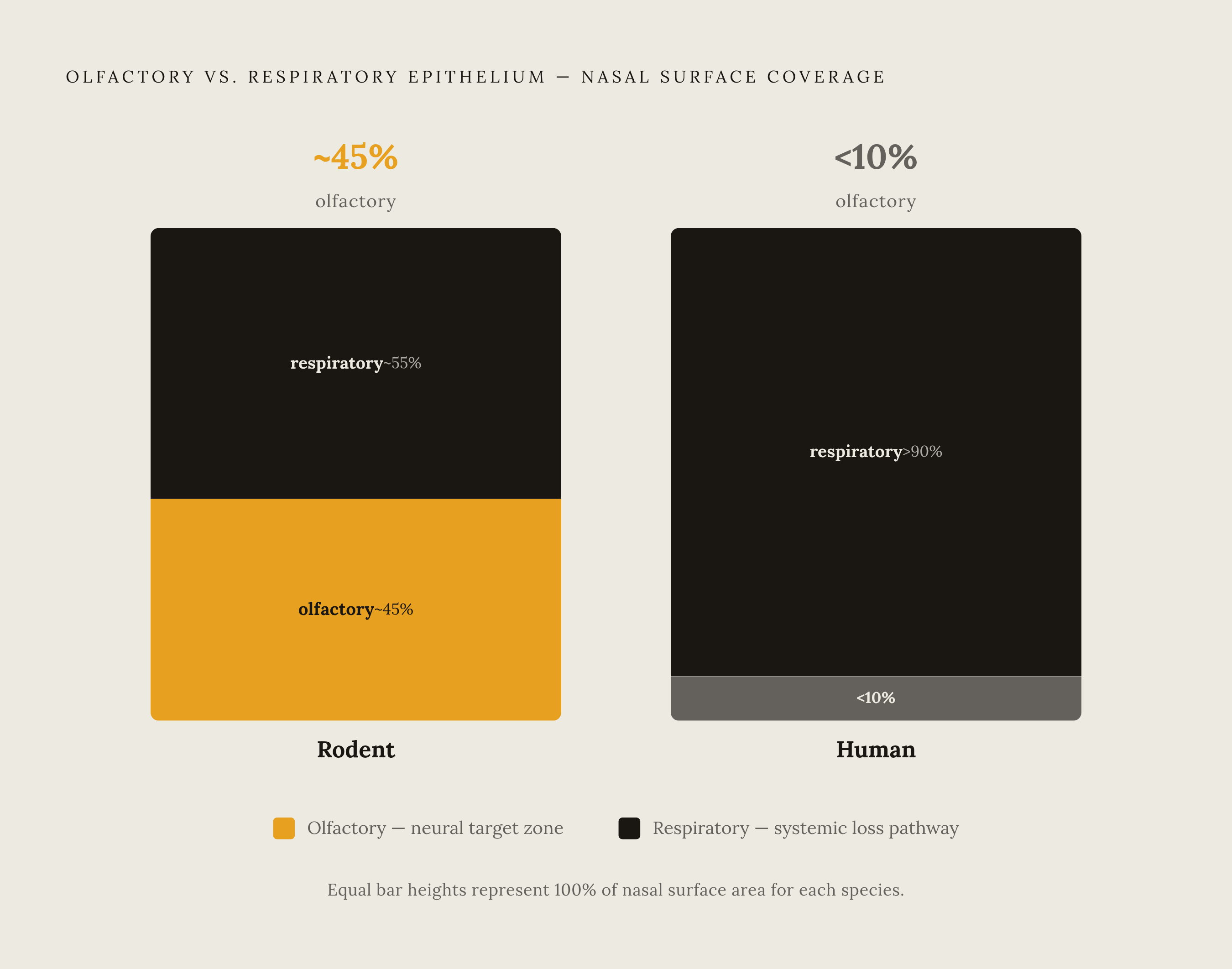
Here is where most formulation strategies quietly fall apart: in rodents, the olfactory epithelium covers something like 40 to 50% of total nasal surface area, but in humans it is under 10%. Most of the foundational nose-to-brain data comes from rats and mice, animals whose nasal anatomy is generously tilted toward the exact pathway researchers want to study. Carrying those results over to humans means carrying them onto a nasal surface where the target zone is a small, hard-to-reach patch near the roof of the cavity, the dominant feature it is in a mouse's snout. Treating mouse data as a direct stand-in for human dosing is one of the more common mistakes in this field, and it is worth staying skeptical of any claim that does not account for that anatomical mismatch.
Geography also creates a hard physical constraint. Only about 100 to 150 microliters can be dosed per nostril, a hard physical ceiling on how much formulation can be delivered. Whatever concentration of peptide a formulation needs, it has to fit inside that volume. There is no room for a dilute solution to make up for a weak concentration; the chemistry has to arrive pre-concentrated, or it fails to arrive.
The olfactory pathway: axonal transport from nose to brain
Drug that lands on the olfactory epithelium makes contact with olfactory sensory neurons directly. From there, transport runs along the olfactory nerve axons, through the cribriform plate, and into the olfactory bulb. Once inside the bulb, the drug has physical access to deeper brain structures, including the hippocampus, the prefrontal cortex, and the hypothalamus, regions where GLP-1 receptors are known to be expressed. None of this touches systemic blood circulation, and none of it requires crossing the BBB. None of this touches systemic blood circulation, and none of it requires crossing the BBB, which is the entire appeal of the route.
But how does the drug actually move along that path? Two separate mechanisms do the work, and they run on very different clocks. One is extracellular: bulk fluid flow through channels alongside the nerve bundles, plus straightforward paracellular diffusion through gaps in the epithelial tight junctions. That route is fast, but it is most effective for smaller molecules. The second mechanism is intracellular: the drug gets taken up by endocytosis into the olfactory neuron's cell body, then physically transported down the length of the axon. That process is slow, sometimes taking hours, but it carries cargo the extracellular route cannot, including full peptides.
Speed and capacity work against each other here, and that tradeoff is the whole story of this pathway. The fast paracellular route cannot move a molecule the size of a therapeutic peptide, and the axonal route that can move a peptide is in no hurry about it. For peptide therapeutics specifically, the olfactory pathway matters because it is the one route an injected or orally dosed peptide simply cannot reach, no matter how it is formulated. It is an option that exists nowhere else in the body, unlike a faster version of an existing option. It is an option that exists nowhere else in the body.
None of that makes the mechanism settled science. No single, confirmed pathway for nose-to-brain transport has been nailed down with certainty, and while the olfactory route has solid evidence behind it, how much of total transport runs through bulk flow versus axonal transport in a living human nose remains an open question.
The trigeminal pathway: a parallel neural highway to the brainstem
Cranial nerve V, the trigeminal nerve, innervates both the respiratory and olfactory regions of the nose through its ophthalmic and maxillary branches, picking up sensory signals from the nasal mucosa and carrying them inward. Following that nerve inward leads somewhere different from the olfactory route, landing at the brainstem, again bypassing the BBB entirely but arriving at a different address than the olfactory-to-cortex axis.
That different address decides which diseases the route is actually good for. Brainstem nuclei govern appetite regulation, nausea and vomiting circuitry, and autonomic function, all territory directly relevant to GLP-1 pharmacology, since GLP-1 receptors appear in those same brainstem structures. A drug aimed at metabolic or certain neurological targets is arguably better served by the trigeminal route than by the olfactory bulb, depending on where its receptor targets actually sit in the brain.
The speed data here is startling, and it deserves to be treated as the anchor fact of this section rather than a footnote. Some preclinical work has documented notably rapid nose-to-brain transit times via the trigeminal route, suggesting certain conjugates may find faster mechanisms than classical axonal transport. That timeline suggests the conjugate found a faster mechanism than classical axonal transport, though the precise route remains unclear.
The limitation is structural, and it echoes the olfactory pathway's own weak point: the drug still has to reach nerve terminals sitting in the nasal mucosa before any of this transport can start. A formulation that diffuses passively through mucus and never associates with a trigeminal nerve ending accomplishes nothing, no matter how promising the downstream biology looks on paper.
Both neural routes share that same dependency. They need the drug to survive contact with the nasal mucosal surface long enough to physically reach a neuron. Which raises the obvious next question: what is actually working against that survival?
The respiratory vascular route: systemic absorption and its limits as a brain-targeting strategy
The respiratory region takes up the largest chunk of nasal surface area, and it is dense with submucosal blood vessels built for rapid absorption. Drug deposited there does not head toward a nerve terminal, it heads into the bloodstream. From there, reaching the brain means crossing the BBB from the vascular side, the exact problem intranasal delivery was supposed to sidestep.
That does not make the respiratory route useless across the board. Small, lipophilic molecules that can cross the BBB passively sometimes benefit from it, since nasal vascular absorption is fast and skips the liver's first-pass metabolism, so onset can be quick. But peptides do not have the passive-diffusion option open to them; their size and hydrophilicity keep them out of the brain even after they have made it into systemic blood. For a peptide therapeutic, landing in the respiratory region is close to a dead end, a loss pathway rather than a delivery pathway, and any formulation strategy that lets a meaningful fraction of its dose drift there is bleeding drug for no therapeutic return.
This tension has been described directly in recent literature: the respiratory region's rich vascularity is what makes it good for rapid systemic absorption, and it works against CNS specificity when the drug in question is a peptide. The same tissue property that makes a route attractive for one drug class makes it a liability for another.
That tension carries a design consequence. Because the human olfactory epithelium covers less than 10% of total nasal surface area against the respiratory region's dominant share, reliable olfactory targeting is not something a simple nasal spray accomplishes by accident. Anyone assuming a standard spray device gets peptide where it needs to go is working from the wrong picture. It takes deliberate, precise deposition, a device engineering problem as much as a chemistry one, and one worth returning to once the biological barriers are laid out in full.
Biological barriers that every pathway must survive
Every route through the nose, olfactory, trigeminal, or respiratory, runs into the same set of obstacles before a peptide gets anywhere close to being absorbed.
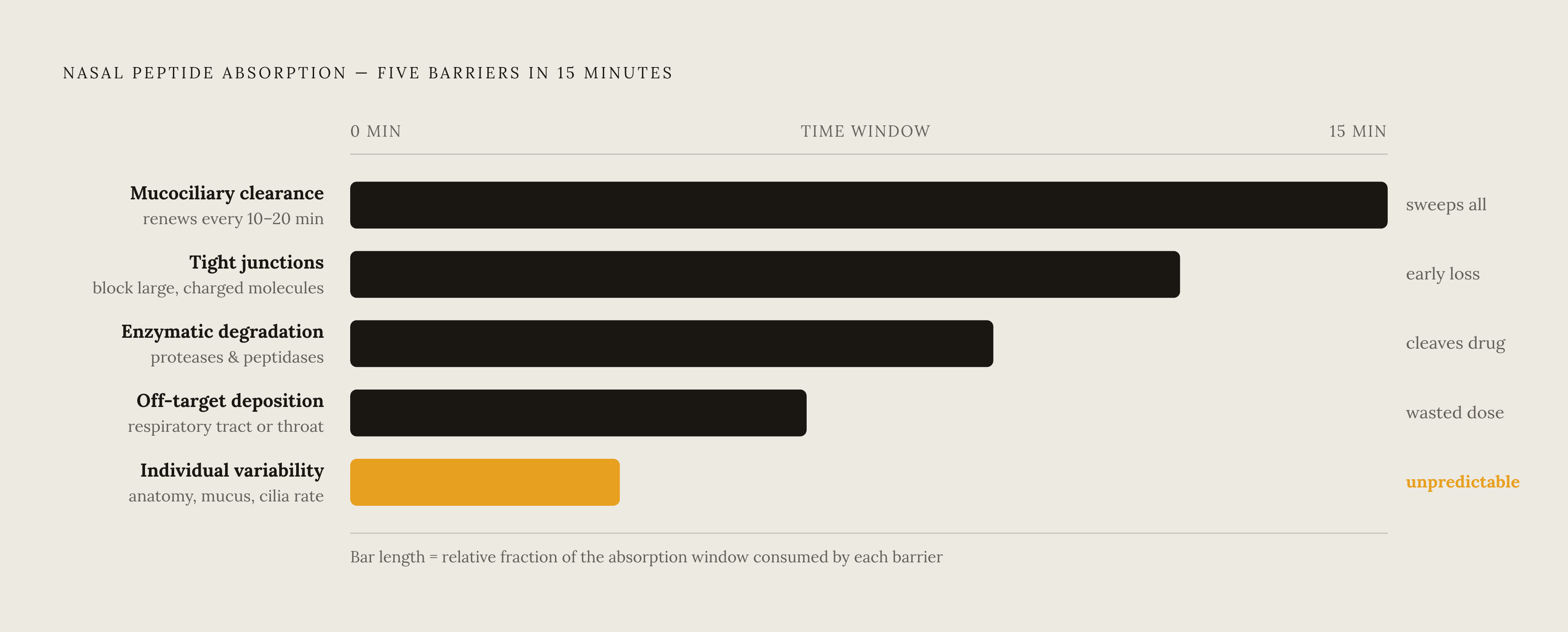
Mucociliary clearance is the first and most punishing. The mucus layer coating the nasal cavity renews roughly every 10 to 20 minutes, a hard clock, with cilia constantly sweeping that mucus, and whatever is dissolved in it, toward the nasopharynx to be swallowed. Peptides are large and hydrophilic, which makes them slow absorbers by nature, so when mucus clears faster than a peptide can cross tissue, the drug gets swallowed instead of doing anything useful.
Tight junctions between epithelial cells present a second wall. These junctions restrict paracellular diffusion by design, and they are particularly effective at excluding molecules that are large and carry charge, which describes most therapeutic peptides fairly well. Researchers have started exploring junction modulators, compounds that transiently loosen these junctions to let more drug through, and Li and colleagues flag this as an active formulation research area in their review.
Then there is enzymatic degradation. Nasal secretions contain proteases and peptidases whose job is to break down foreign protein material, and a peptide sitting unprotected in that mucus layer is a target for exactly that machinery. Encapsulating the peptide inside a nanocarrier shields it from that enzymatic exposure, one of the clearest, most concrete reasons the nanocarrier approach exists.
Two more barriers are less about biology and more about handling. Off-target deposition happens when administration technique is imprecise: drug ends up on the respiratory epithelium and gets absorbed systemically, or it runs down into the throat and gets swallowed outright, neither of which reaches a neuron. Individual variability, differences in nasal anatomy, mucus composition, and how fast cilia beat from one person to the next, adds noise on top of that. A first-in-human PET imaging study by Winterdahl and colleagues in 2025 documented exactly this kind of variable brain uptake across subjects, a reminder that a mechanism demonstrated in controlled animal studies does not automatically behave the same way across a diverse human population.
A free, unprotected peptide put into a nasal spray has to survive all of that, clearance, tight junctions, enzymes, imprecise dosing, individual variation, inside a window of roughly 15 minutes. That is a lot to ask of a molecule with no defenses of its own, and it is exactly the gap nanocarrier engineering exists to close.
What nanocarriers do that free peptides cannot
A nanocarrier does three things a bare peptide cannot manage alone: it shields the payload from enzymatic attack, it extends how long the formulation sticks around on nasal mucosa, and it gives engineers a surface to modify so the whole particle gets steered toward a specific pathway rather than drifting wherever mucus flow happens to carry it.
Several carrier architectures have become the workhorses of the field. PLGA nanoparticles are biodegradable, can carry both water-loving and fat-loving drugs, and have been studied extensively for CNS delivery; their controlled-release profile lets the peptide payload keep leaking out slowly, well past the point where free mucus would have already cleared it. Solid lipid nanoparticles, or SLNs, handle peptides, larger proteins, and even gene therapies, and their lipid matrix sticks naturally to mucus and has an affinity for cell membranes. Lipid nanoparticles, the LNP family, showed up in a 2025 Alzheimer's-focused study published in Acta Pharmaceutica Sinica B, where lactoferrin-functionalized LNPs co-encapsulated α-mangostin alongside an siRNA targeting a protein linked to amyloid production, delivered together through the nose-to-brain route, showing that a single carrier can haul more than one type of cargo at once. Liposomes, polymeric micelles, and dendrimers round out the toolkit, each with its own tradeoffs in drug-loading capacity and how easily its surface takes chemical modification.
A newer, more biological option is the exosome. Qiu and colleagues describe exosomes in their 2025 MedComm paper as a nose-to-brain delivery platform that exploits the cell's own natural uptake machinery rather than relying on synthetic chemistry to force entry. That is a meaningfully different design philosophy. Instead of building an artificial particle and hoping the body does not reject it, exosomes borrow a delivery system the body already runs constantly, which may end up mattering more for long-term tolerability than any single efficacy number.
Size turns out to be one of the more decisive variables in this whole picture, and it deserves more weight than it usually gets in comparisons between carrier types. Smaller particles get a shot at the paracellular and extracellular routes, the fast ones, while larger particles are locked into relying on endocytosis and slow axonal transport. Carrier size is not a manufacturing footnote; it is a decision about which of the pathways described earlier the formulation is even eligible to use.
Surface engineering strategies that direct nanocarriers toward neural targets
Building the right carrier core only covers half the job. What sits on the outside of that carrier decides how long it lingers before absorption and how close it ends up to a neuron.
Mucoadhesive coatings are the most established of these surface tricks. Polymers that bind to mucin glycoproteins in nasal mucus extend how long a formulation stays put, buying extra time against that 10-to-20-minute clearance clock. Cell-penetrating peptides, or CPPs, take a different approach, conjugated directly onto a nanoparticle's surface to help it punch through cell membranes and escape endosomes once taken up. The GLP-2/CPP conjugate that reached the trigeminal sensory nucleus in three minutes stands as the strongest evidence in the field that this particular strategy can produce dramatic, measurable speed gains, and any surface engineering roadmap that ignores CPP conjugation is leaving real performance on the table.
Targeting ligands work through a different logic entirely: they bind specific receptors on nasal epithelial cells or on BBB endothelial cells, nudging the carrier toward active transport across a membrane instead of passive diffusion through it. Ligands built around the transferrin receptor exploit how densely that receptor sits on brain capillary endothelium. Angiopep-2 targets receptors on BBB cells, and lactoferrin, mentioned earlier in the 2025 LNP example, was shown to direct nose-to-brain delivery toward Alzheimer's-relevant molecular targets along the β-amyloid and BACE1 pathway.
PEGylation, coating a particle in polyethylene glycol, functions closer to a stabilization tactic than a targeting one. It improves how well the particle stays suspended, cuts down on immune-system tagging for clearance, and tends to improve how well the particle moves through mucosal tissue. Biomimetic nanoparticles push that same instinct further, building the carrier out of physiological proteins, actual cell membranes, or viral coat proteins, borrowing nature's own uptake pathways instead of asking synthetic chemistry to imitate them from scratch, with the added benefit of provoking less of an immune response. Environmentally responsive designs, formulations engineered to release their payload only when triggered by a specific pH, temperature, or enzyme signal, get singled out by Li and colleagues in their February 2026 review as one of the more active frontiers in the field right now, precisely because they let a carrier hold its cargo until it is actually sitting in the right anatomical spot.
How researchers measure whether drug reached the brain
None of the mechanisms above matter if there is no way to confirm they are working, and that turns out to be one of the field's most stubborn practical problems. Direct measurement of drug concentration inside a living human brain, without some invasive sampling procedure, is not something most research settings can do. A lot of what gets cited as evidence is really a proxy standing in for the thing researchers actually want to know.
Preclinical work leans on surrogate numbers instead. Drug-targeting efficiency, or DTE, compares the area under the concentration curve for brain tissue after intranasal dosing against the same measurement after intravenous dosing, giving researchers a ratio that shows how the nasal route performs against a straightforward injection at getting drug into brain tissue. A DTE value above baseline parity suggests the nasal route carries some genuine targeting advantage rather than just being a slower way to reach the same systemic exposure.
That works fine in animals, where researchers can sacrifice tissue and measure directly. Humans are a different problem, one that pushes the field toward imaging techniques like PET, the same approach used in the 2025 first-in-human study by Winterdahl and colleagues that documented the variability in brain uptake mentioned earlier. Even there, the numbers only tell part of the story: a drug might show up on a PET scan without having reached its intended neural targets, and separating those two locations cleanly is a technical challenge of its own. The honest state of the field, at least as reflected in the work these sources cover, is one where transport mechanisms are increasingly well mapped anatomically, while measuring their real clinical payoff in humans is still catching up to that anatomical picture, and anyone claiming otherwise is ahead of the actual data.
Sources
- Challenges and strategies for nose-to-brain delivery in treating neurological disorders - PubMed
- Intranasal drug delivery: Unlocking the nose-to-brain route for central nervous system therapies - ScienceDirect
- The Nasal–Brain Drug Delivery Route: Mechanisms and Applications to Central Nervous System Diseases - Qiu - 2025 - MedComm - Wiley Online Library
- researchgate.net
- researchgate.net