GLP-1 Nausea Mechanisms and the Gut-Brain Signaling Pathway
Selective brain circuits could separate weight loss from nausea without compromising either.
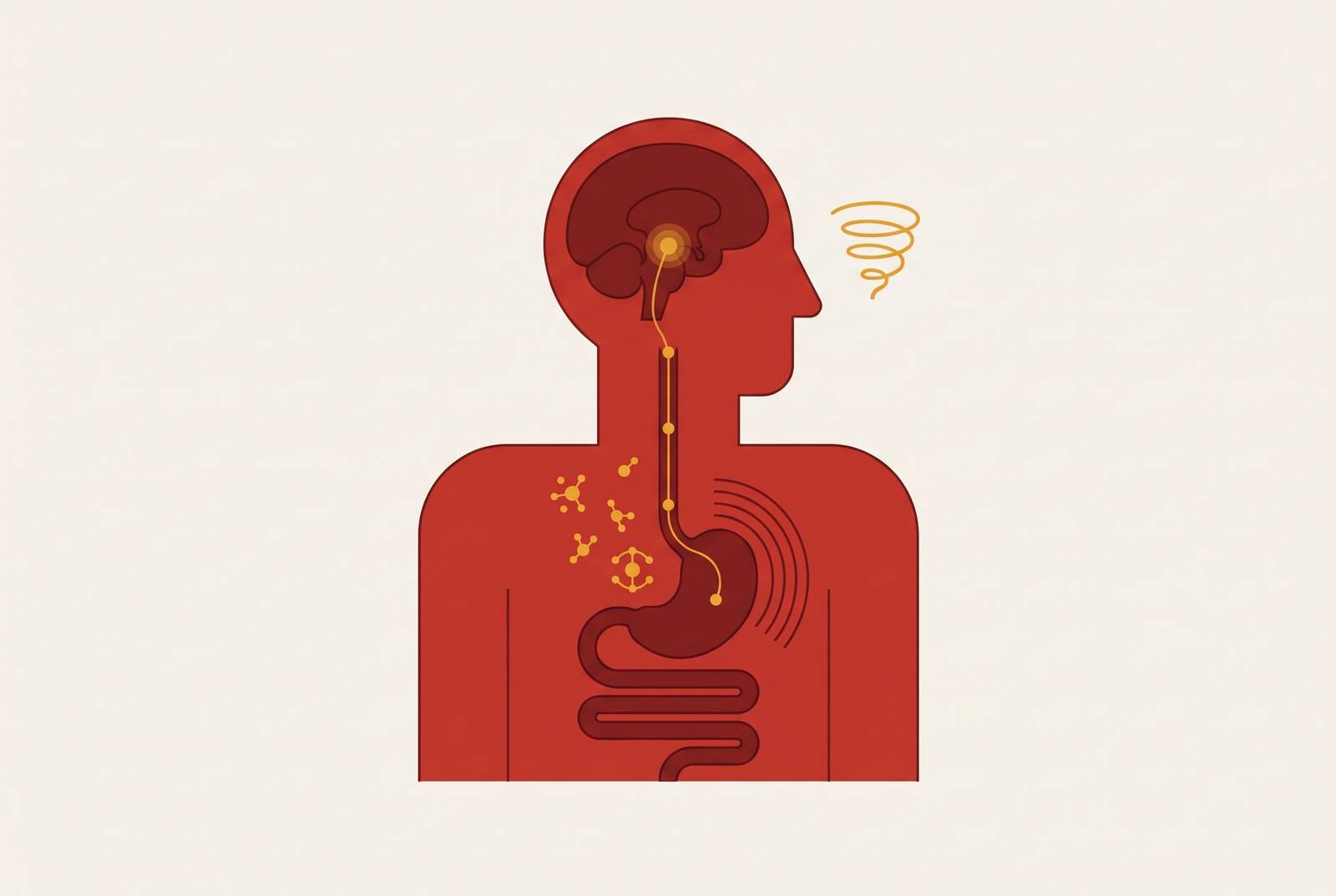
GLP-1-induced nausea is a predictable consequence of the gut-brain signaling pathway that also supports treatment benefits. Dose pauses within clinician-guided titration are the best current tool for reducing nausea-driven dropout, while leaving the underlying mechanism intact. The deeper opportunity is to separate satiety from nausea through more selective circuit engagement and drug delivery, an approach that remains clinically unresolved.
What GLP-1 is and where it acts — the hormone’s natural role before pharmacology enters the picture
GLP-1 is an incretin hormone released by enteroendocrine cells in the gut after nutrient ingestion. It stimulates insulin, suppresses glucagon, and helps regulate appetite and satiety. A meal sends a message that links metabolic responses with the feeling that enough food has been eaten.
The enzyme DPP4 rapidly degrades endogenous GLP-1, limiting how long that message lasts. Pharmacological analogues were developed to extend and amplify its effects, changing the duration and intensity of signaling within an existing biological function. That distinction is central to understanding adverse effects. GLP-1 receptors are distributed across the gut, vagus nerve, and multiple sites in the central nervous system, giving an amplified signal several places to act.
The anatomy of the gut-brain axis that GLP-1 receptor agonists exploit — and overload
GLP-1 receptor agonists reduce how much people eat mainly by activating receptors at several central nervous system sites, though how much each site contributes is still debated. Within that network, the dorsal vagal complex is a key integration hub. It comprises the nucleus tractus solitarius, or NTS, the area postrema, and the dorsal motor nucleus of the vagus nerve. Here, signals from the gut meet signals carried through the blood. Their convergence creates the anatomical chokepoint where efficacy and tolerability collide.
The area postrema sits outside the blood-brain barrier, so it can sense drug concentrations in the blood without the drug having to cross the barrier fully. It acts as a chemosensory trigger zone. In parallel, vagal afferents transmit GLP-1 receptor-mediated signals from the stomach to the dorsal vagal complex. Pharmacological doses can activate both channels simultaneously, compounding the input into this brainstem hub. Because the same region receives satiety signals and governs the emetic reflex, stronger signaling does not arrive in an anatomical compartment reserved for appetite control.
Why nausea and satiety arise from the same brainstem circuitry — and why they are not identical
Partially different neuronal populations within the same brainstem nuclei may produce satiation and nausea, giving the two effects partly separate routes through a common hub. Rodent evidence supports this circuit-separability hypothesis, but it is not human proof. The distinction changes the central research question. Research can now ask whether treatment can act more selectively on one neuronal population than another, instead of asking whether stronger satiety must bring greater nausea.
Peripheral effects complicate that task because receptor agonists also slow gastric emptying. The stomach stays fuller for longer, so it keeps sending mechanical distension signals to a brainstem that the drug has already activated. These inputs can reinforce each other. Nausea is dose-dependent and tends to peak during escalation, when plasma concentrations are rising and brainstem adaptation has not yet occurred. As treatment continues, brainstem circuits likely adapt in ways that help explain why symptoms ease for many patients over weeks to months.
Pooled trial data show substantial weight loss among patients without gastrointestinal side effects, although those with such effects tend to lose slightly more. The difference does not establish that nausea drives efficacy. A 2026 mediation analysis found that gastrointestinal adverse events accounted for less than 1 percentage point of the additional weight loss with semaglutide versus placebo. Substantial weight loss without nausea is therefore the strongest clinical evidence that the therapeutic effect and the adverse experience are not the same mechanism.
How the GLP-1 receptor itself signals — and why that matters for tolerability engineering
The endogenous system regulates not only hormone breakdown but also release. Conley et al. at Indiana University showed that GPR17, expressed in approximately 74% of enteroendocrine cells that secrete the endogenous hormone in the human small intestine, suppresses secretion of that hormone through a Gi/o-dependent mechanism. That effect was not directly correlated with whole-cell cAMP signaling. GPR17 regulates secretion upstream of the GLP-1 receptor, so the finding identifies an upstream brake whose relevance to nausea-specific signaling remains to be established.
Pharmacological agonists bypass that brake on endogenous release. They reach receptor sites at concentrations and for durations that the natural hormone does not achieve, while the brainstem’s chemosensory zone encounters exposure shaped by the formulation. Receptor pharmacology and delivery are therefore connected levers. The hypothesis that a lower plasma peak, or delivery to central targets without a large systemic spike, could reduce the burden on emetic circuitry while retaining satiety signaling remains to be demonstrated in patients.
The tolerability problem across the current class of agents — single-target and multi-agonist alike
Alhazmi & le Roux’s 2026 opinion article in Frontiers in Endocrinology frames nausea and vomiting as a central clinical challenge for long-term treatment persistence. These effects remain frequent and disruptive as receptor-agonist therapy expands into multi-agonist and oral agents. Roughly a third to two-fifths of patients struggle during escalation, developing nausea, vomiting, or treatment-limiting intolerance. The rest reach full therapeutic doses with little difficulty. There is currently no reliable way to predict before treatment which group a patient will enter.
Oral formulations illustrate why convenience and tolerability are different problems. Oral semaglutide has very low and highly variable single-dose bioavailability, although variability falls substantially at steady state. Its larger plasma fluctuations relative to subcutaneous dosing likely contribute to gastrointestinal adverse effects. Yet orforglipron, a small-molecule agonist with more predictable absorption, shows similar gastrointestinal tolerability despite that pharmacokinetic advantage.
The best current clinical tool is the existing titration framework, with nausea treated as physiological feedback that can prompt clinician-guided dose pauses while allowing treatment to continue. The analogy in the clinical framing is mild hypoglycemia during insulin titration, a signal to adjust dosing while retaining the therapeutic goal. This approach allows treatment intensity to respond to tolerability. It does not eliminate the anatomical overlap between the desired signal and the adverse one.
Why do patients quit GLP-1 treatment early, and how does nausea create a treatment gap?
Patients who stop before reaching a therapeutic dose or taking it for long enough miss out on the full benefits of sustained therapy. Physicians most frequently cite nausea or vomiting as the reason their patients stop, and patients themselves most frequently report the same symptoms. The accounts point to a shared burden. Their agreement argues against treating nausea-driven dropout simply as a communication problem.
Discontinuation is disproportionately concentrated in the early weeks, when escalation exposes the brainstem to rising plasma concentrations and gastric adaptation has not yet occurred. Patients without type 2 diabetes discontinue at substantially higher rates than patients with diabetes. One possible explanation is that the metabolic urgency of diabetes provides a motivation buffer against nausea, an interpretation of patient motives that remains unproven. The difference highlights how the same adverse effect can translate into different patterns of persistence.
A therapy can have substantial efficacy yet deliver less benefit when its tolerability limits how long patients take it. Alhazmi & le Roux emphasize that sustained, long-term therapy is needed to optimize metabolic, cardiovascular, and weight-related benefits. Nausea therefore becomes more than a transient symptom. When it ends treatment prematurely, the drug’s own pharmacology helps create a gap between its therapeutic potential and the benefit patients receive.
The broader neurological reach of GLP-1 circuitry — reward, addiction, and dementia as downstream territories
The brainstem is not the outer boundary of GLP-1 signaling. Receptors are also found in brain areas that play a part in impulse control, reward, and addiction, so their reach goes beyond appetite suppression. Preclinical studies show that receptor agonists can re-tune mesolimbic circuits controlling food reward. Those findings suggest possible relevance to binge eating and compulsive consumption patterns. They do not establish clinical efficacy for eating disorders or addiction.
The null result in established dementia limits any broad claim that receptor-agonist treatment improves neurological outcomes. Prevention and treatment are not interchangeable tests. An unsuccessful result after disease is established neither proves a preventive benefit nor settles whether earlier intervention could act differently.
If a neurological benefit depends on chronic, low-level receptor engagement in brain circuits rather than metabolic correction, then achieving that exposure directly could become therapeutically important. Systemic exposure would no longer be a sufficient guide to target engagement. What would matter is how much drug reaches the intended circuit, for how long, and with what nausea burden. That shifts attention from the amount administered to the distribution achieved.
Why the delivery route is the mechanism — and what it means to target the brain directly
Systemic delivery exposes the area postrema to circulating drug concentrations before selective engagement of deeper brain targets can be assumed. Subcutaneous injection produces systemic plasma peaks that this chemosensory region can sample directly. If nausea and therapeutic benefit depend partly on different neuronal populations, changing the route could alter their relative engagement. It would not automatically do so, because reaching the brain is not the same as selecting a circuit within it.
The nasal route offers access through olfactory and trigeminal nerve pathways without requiring systemic saturation to achieve brain exposure. A first-in-human PET study using labeled intranasal oxytocin demonstrated that an intranasally administered peptide can reach human brain tissue, but uptake was low and variable. That is evidence of access, not GLP-1 efficacy. The useful pharmacokinetic criterion is the brain-to-plasma ratio, which describes central exposure relative to systemic exposure. A favorable ratio could lower the systemic load linked to area postrema activation and peripheral gastric slowing, as long as enough drug reaches the intended targets.
Polymeric nanoparticles can protect peptides against enzymatic degradation and extend release, while mucoadhesive carriers enable site-specific intestinal delivery. For nose-to-brain delivery, prior studies have shown that gold nanorod conjugates can reach the brain with minimal systemic exposure. Animal models also show improved brain bioavailability with cell-penetrating peptide conjugation, which can enhance membrane translocation and protect against degradation during transit.
These approaches remain mechanistically rational research directions rather than established solutions to nausea-driven discontinuation. Their evaluation must distinguish brain access, selective circuit engagement, and preserved therapeutic benefit with less nausea. None can be inferred from the others alone. The area postrema and vagal pathways explain why simply amplifying GLP-1 signaling creates a tolerability burden, while circuit separability explains why that burden may be reducible.
Sources
- G protein-coupled receptor 17 inhibits glucagon-like peptide-1 secretion via a Gi/o-dependent mechanism in enteroendocrine cells
- Frontiers
- GLP-1 and the Neurobiology of Eating Control: Recent Advances
- Neurobiological Mechanisms and Therapeutic Potential of Glucagon-like Peptide-1 Receptor Agonists in Binge Eating Disorder: A Narrative Review
- Intranasal delivery of glucagon-like peptide-1 to the brain for obesity treatment: opportunities and challenges: Expert Opinion on Drug Delivery: Vol 21 , No 7 - Get Access