Why Large-Molecule Peptides Require Nanoparticle Encapsulation to Survive the Nasal-to-Brain Transit
Nasal nanoparticles shield peptides from clearance, enzymatic attack, and epithelial barriers.

Nanoparticle nose-to-brain delivery for CNS peptide indications aims to bypass the blood–brain barrier through olfactory and trigeminal pathways. Large-molecule peptides need protection because nasal clearance, enzymatic degradation and epithelial impermeability limit their access to those pathways. Encapsulation offers a way to address all three barriers, but successful transport in animals is not yet proof of therapeutic brain exposure or clinical benefit in humans.
Why the nasal-to-brain route exists and why peptides cannot use it unassisted
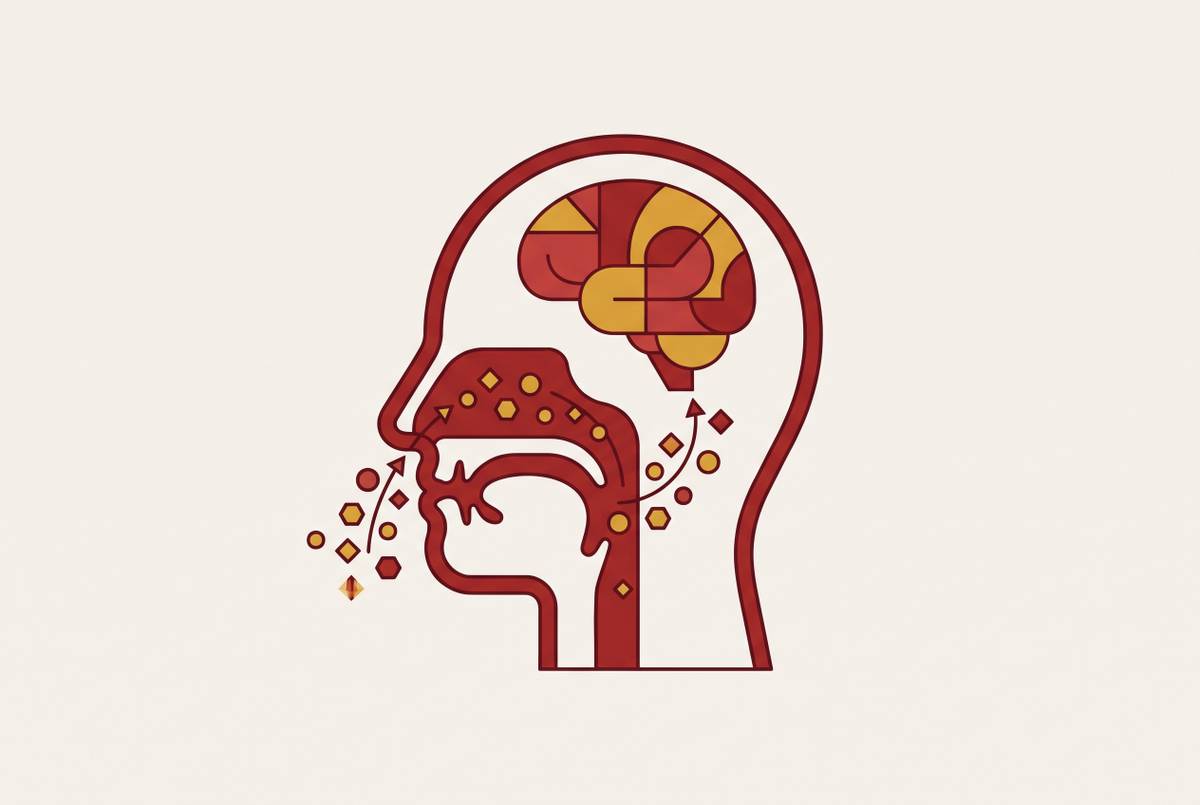
The olfactory and trigeminal nerves provide anatomical connections between the nasal cavity and the central nervous system. Material using these pathways can bypass the blood–brain barrier. The distinction is central to the delivery argument. A nasal formulation does not make the blood–brain barrier permeable to peptides, but seeks another entrance.
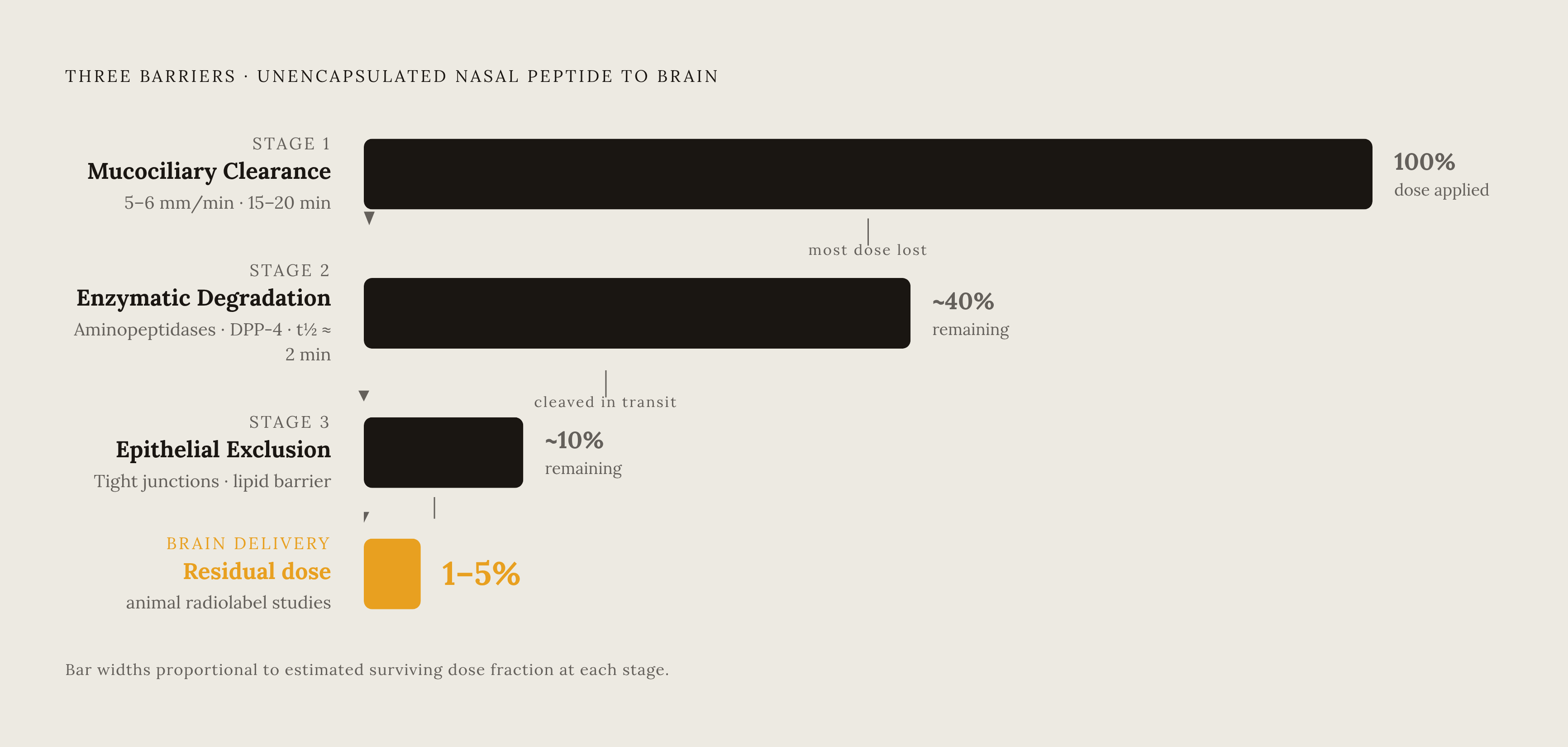
Yet anatomical access does not confer molecular access. GLP-1 is a 30- or 31-amino-acid incretin peptide whose size and architecture make it vulnerable to degradation, while its hydrophilic character limits membrane permeability. Animal radiolabel studies cited in the brief suggest that roughly 1–5% of an unassisted nasal peptide dose reaches the brain. That estimate illustrates the gap between depositing a molecule in the nose and delivering it to neural tissue. The pathway exists, while three barriers obstruct entry.
Barrier one: mucociliary clearance removes most of a nasal dose within minutes
The nasal epithelium has a mucus blanket that cilia propel toward the nasopharynx at roughly 5–6 mm per minute. This active conveyor clears most deposited material within 15–20 minutes. It treats a deposited therapeutic much as it treats inhaled particles, moving it away while absorption is still competing for the dose. The available window is measured in minutes.
Placement makes that clock more demanding. The olfactory region has a surface area of roughly 5 cm² and accommodates only a limited volume, restricting how much drug can be deposited near the intended entry pathway. More drug is absorbed by the respiratory epithelium than by the olfactory epithelium, further separating nasal absorption from direct brain delivery. A peptide in free solution has no built-in means of resisting mucus flow. Even correct deposition therefore leaves an unresolved question about whether the molecule can enter tissue before it is removed.
Barrier two: enzymatic degradation in the nasal mucosa destroys peptide structure before absorption
Remaining in the nose does not mean remaining intact. Airway surface liquid and mucus contain aminopeptidases and other proteases capable of cleaving peptide bonds. Clearance removes molecules from the delivery site, while proteolysis changes the molecules themselves. A cleaved peptide cannot simply reassemble into its active structure. Each loss leaves less of the dose intact for absorption.
Native GLP-1 makes the threat especially concrete. Dipeptidyl peptidase-4, or DPP-4, degrades it with a half-life of roughly two minutes in systemic circulation. That figure demonstrates acute enzymatic vulnerability, but it is not a measured nasal half-life and does not establish a faster nasal degradation rate. In the nose, susceptible peptides encounter proteolytic activity while their opportunity for absorption is already short. Clearance and degradation run in parallel, so prolonging residence without preserving structure may merely prolong exposure to enzymes.
Barrier three: tight junctions in the nasal epithelium block the paracellular route even for intact peptides
Suppose a peptide remains near the epithelium and survives enzymatic attack. It still faces a structural barrier at the tissue surface. Tight junctions are protein complexes that close the gaps between neighboring epithelial cells, limiting how much a molecule can pass through the paracellular route. Large, hydrophilic peptides cannot readily use those sealed spaces.
The alternative path through the cell is also difficult. A peptide’s size and polarity make it hard for it to partition into the lipid membrane, and it must keep its three-dimensional structure to work as intended. What makes the molecule useful as a receptor agonist does not make it easy to transport. Clearance can remove the dose, enzymes can destroy the retained fraction, and the epithelium can exclude the intact remainder. Although these processes overlap in time, they form a sequence of delivery requirements, each capable of defeating an otherwise promising formulation.
How nanoparticle encapsulation addresses each barrier in the sequence it appears
Against clearance, a nanoparticle can use surface chemistry to change its interaction with mucus. Positively charged chitosan interacts with negatively charged mucin glycoproteins, producing mucoadhesion that slows removal and extends contact with the epithelium. Ahmad et al. (2022) reported approximately two-fold greater absorption of L-DOPA formulated as chitosan nanoparticles than of unmodified L-DOPA, using area under the curve as the bioavailability measure. The evidence comes from L-DOPA in animals and does not show that a protected peptide can be delivered to the human brain.
Mucopenetrating surfaces take a different approach to the same mucus layer. Hydrophilic, neutral PEG coatings avoid strong adhesion to mucins, allowing particles to move through mucus toward the epithelial surface. Adhesion and penetration are not interchangeable properties. One strategy seeks longer local residence, while the other seeks faster passage through obstructive mucus. Their value depends on how well they help particles through the next transport step, and detecting particles still in the nose does not show that.
Against degradation, polymeric shells such as PLGA or chitosan, or lipid bilayers, physically separate the peptide from proteases. The encapsulated payload is less accessible to enzymatic attack until release. Protection changes the molecule’s exposure to its environment. It does not give every GLP-1 analog native GLP-1’s two-minute systemic half-life or show how long a protected peptide will last. The relevant distinction is between an exposed peptide and one shielded during transit.
Against epithelial impermeability, surface engineering promotes cellular uptake rather than relying on passage between tightly joined cells. Cell-penetrating peptides, or CPPs, can facilitate membrane translocation, allowing the carrier to use a transcellular route. Once inside olfactory or trigeminal neurons, nanoparticles can exploit axonal transport toward the brain. Particle size, including designs in the 1–100 nm range, also affects uptake, though size alone does not show that transport succeeds.
Why GLP-1 peptides make the most clinically consequential test case for this delivery problem
GLP-1 brings together a difficult payload and substantial neurological interest. Its receptors occur in pancreatic islets, the central and peripheral nervous systems, cardiovascular tissues, kidneys, lungs and the gastrointestinal tract. This distribution helps explain therapeutic effects beyond glucose control. For a CNS indication, however, receptor presence is only the beginning. Enough active drug must reach the neural tissue where it is needed.
Systemically administered GLP-1 receptor agonists have limited brain access through specialized uptake around circumventricular organs. Intranasal GLP-1 analogs in animal models have shown widespread brain distribution, with highest uptake in the hippocampus and neocortex within 30 minutes. In Alzheimer’s animal models, GLP-1 receptor agonists have reduced amyloid-β and tau pathology, decreased neuroinflammation and enhanced synaptic plasticity. Those findings establish mechanistic interest, with clinical efficacy and the achievability of the same exposure in humans still unproven.
Addiction research raises a related question about access to reward circuitry. Khaled Moussawi’s work at UCSF focuses on the dual GLP-1/GIP compound brenipatide, targeting craving and drug use. These circuits include the nucleus accumbens, which lies inside the blood–brain barrier. A nasal route also offers noninvasive self-administration and avoids hepatic first-pass metabolism, unlike the practical burden of subcutaneous dosing. These advantages give reason to develop the route, but ease of use does not show that the drug reaches the brain.
What the failed systemic Alzheimer's trials reveal about route, not mechanism
The EVOKE and EVOKE+ trials enrolled 3,808 participants with mild cognitive impairment or mild dementia confirmed by amyloid status. They tested once-daily oral semaglutide against placebo and found that it did no better at slowing progression as measured by the primary clinical dementia rating endpoint. The unambiguously negative clinical result for that endpoint cannot be set aside because a different delivery route appears promising.
Even so, the trials showed improvements in disease-associated biomarkers. Biological effects therefore occurred without measurable slowing of clinical decline. That distinction leaves an important question open. Did the intervention fail because relevant brain compartments received insufficient exposure, because the biological effects were insufficient to change the disease course, or for reasons the endpoint and biomarker results cannot resolve? Too little exposure in the target tissue could explain the failure, but this has not been shown.
The route argument must remain within that evidentiary boundary. These trials tested a systemically administered drug, leaving direct nose-to-brain delivery of a nanoparticle-protected peptide untested. They neither establish that nasal delivery would work nor eliminate it as a distinct hypothesis. Biomarker changes also do not identify which compartments received therapeutically meaningful concentrations. The implication for trial design is that route and brain exposure remain variables to test, rather than explanations that can be assumed after failure.
The translational obstacles that remain between nanoencapsulated nasal peptides and the clinic
Human dose quantification is the first unresolved challenge. A nasal dose may reach the brain, enter systemic circulation, undergo local metabolism or be lost through exhalation. Measuring those fractions precisely is difficult. Animal radiolabel studies inform development but do not map cleanly onto human anatomy and physiology. Without reliable human dose–brain concentration data, formulation optimization depends on imperfect extrapolation.
Infection, allergy, inflammation and age can change mucus viscosity, ciliary beat frequency and enzyme expression. These changes affect the barriers themselves. A carrier optimized under healthy-tissue assumptions may therefore encounter a different balance of clearance, degradation and epithelial access in practice. The formulation has to function within that variability.
Manufacturing introduces a separate demand for consistency. Producing the required particle size, surface charge and functionalization at commercial scale is not an automatic extension of bench-scale synthesis. Regulatory assessment adds another layer of complexity because a novel vehicle, peptide payload and CNS indication do not fit neatly within frameworks designed for conventional small-molecule nasal sprays. A reproducible particle still needs an assessable path to clinical use.
Intranasal oxytocin and insulin illustrate why that distinction deserves attention. Both have shown encouraging preclinical pharmacokinetics in nose-to-brain research, yet both have faced problems in moving to clinical use that preclinical models did not predict. Their experience limits what animal success can establish. Dose measurement, variable tissue conditions, scalable manufacture and regulatory review remain substantive work, even when the transport rationale is sound. They make translation hard without establishing that it is impossible.
What the three-barrier framework means for how nose-to-brain peptide delivery gets built
The three-barrier framework becomes a design specification for the delivery platform. A mucus-interacting surface must support access before clearance, a protective shell must preserve the payload, and a cell-entry mechanism must overcome epithelial exclusion. These functions must also remain compatible with one another. A PEGylated mucopenetrating surface and a chitosan mucoadhesive surface embody different trade-offs, so neither can be judged by residence time alone. The design succeeds only if each transport step enables the next.
To meet that requirement, the peptide and carrier must be designed together instead of being mixed after each has been optimized on its own. The carrier’s purpose is to bring intact peptide to the neural entry pathway in time and at a concentration sufficient for uptake. Each measurement answers a different question.
Surveyed patients cited nausea as their principal reason for abandoning GLP-1 treatment at a rate of 64.4%, while subcutaneous administration imposes a needle burden that nasal administration avoids. Whether a particular nasal platform also reduces peripheral exposure and nausea requires evidence. The forward-looking task is therefore not simply to replace an injection with a spray, but to connect protection, transport and release in a reproducible delivery system.
Sources
- Polymeric Nanocarrier-Based Drug Formulations for Enhancing Nose-to-Brain Delivery
- Cell-Penetrating Peptide-Decorated Nanovectors for Nose-to-Brain Delivery: A New Treatment Option for CNS Diseases
- Full article: A comprehensive insight of innovations and recent advancements in nanocarriers for nose-to-brain drug targeting
- Overcoming barriers: nanomedicine-based strategies for nose-to-brain delivery
- Advanced intranasal peptide delivery systems for improved management of Alzheimer's disease - PubMed
- Intranasal delivery of glucagon-like peptide-1 to the brain for obesity treatment: opportunities and challenges: Expert Opinion on Drug Delivery: Vol 21 , No 7 - Get Access
- Nose-to-Brain Drug Delivery