GLP-1 Pharmacokinetics and Half-Life Engineering in Approved Analogs
Chemists engineered GLP-1's fatal flaw—its two-minute lifespan—into drugs dosed weekly.
GLP-1 drugs work because chemists solved a problem the human body already gave up on. Native GLP-1 lasts minutes in the bloodstream before it's destroyed, and every structural trick in the approved drug class, from a single amino acid swap to a fatty acid tail dangling off a lysine residue, exists to answer that one limitation. Tracing how liraglutide became semaglutide shows the actual engineering logic at work, and it also shows where that logic runs out of road.
Why native GLP-1 is therapeutically useless without structural intervention
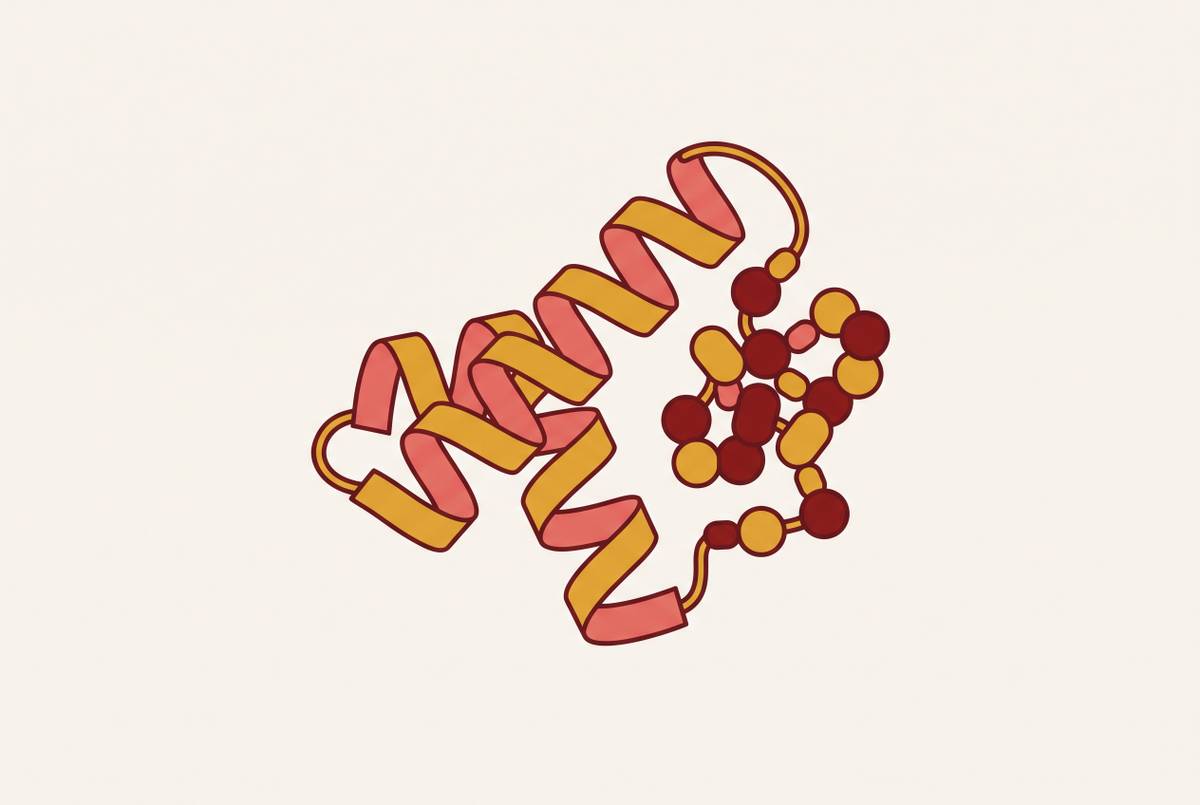
GLP-1 itself is a small molecule, just 30 amino acids strung together, released by cells in the gut lining after a meal. Its job, physiologically, is straightforward: prompt the pancreas to release insulin when glucose is around, and dial down glucagon so the liver doesn't dump more sugar into circulation than the body needs. None of that is in dispute, and none of it is the hard part.
The hard part is timing. That's not a manufacturing problem or a formulation quirk. It's a fundamental mismatch between how the body clears the molecule and how a drug needs to behave to be dosed on any reasonable schedule.
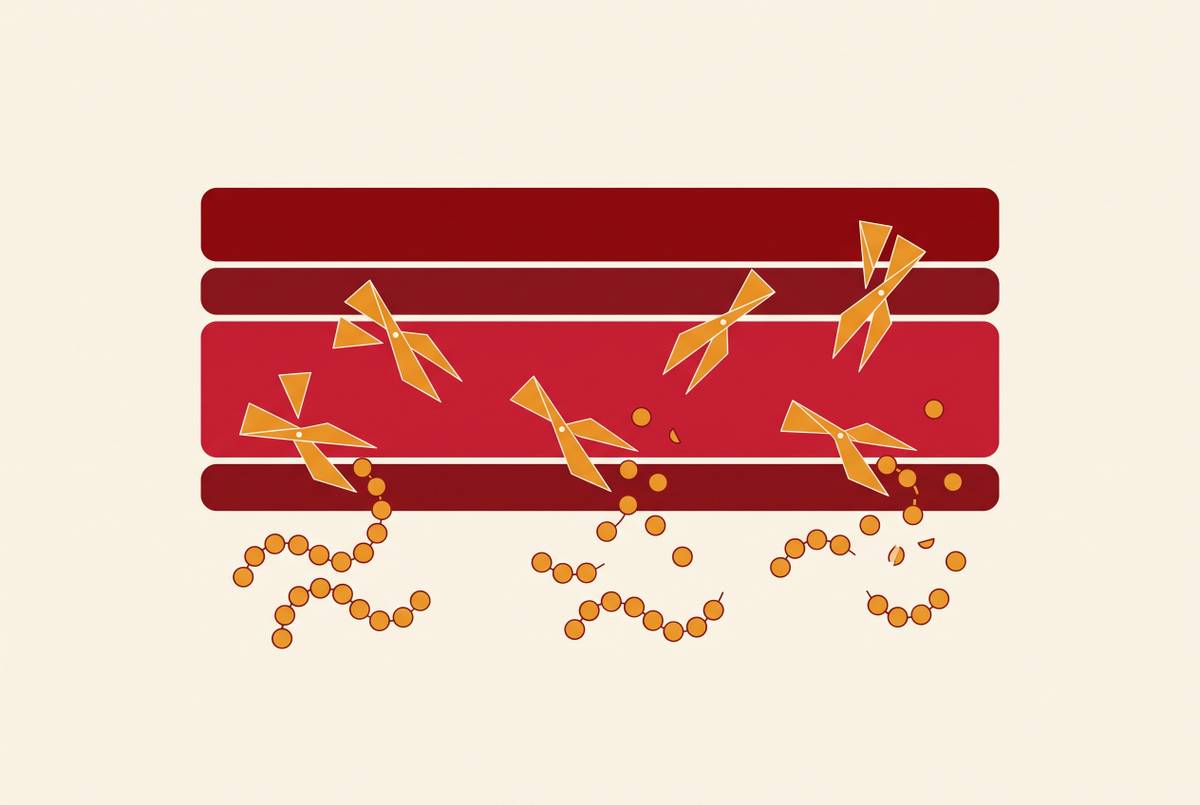
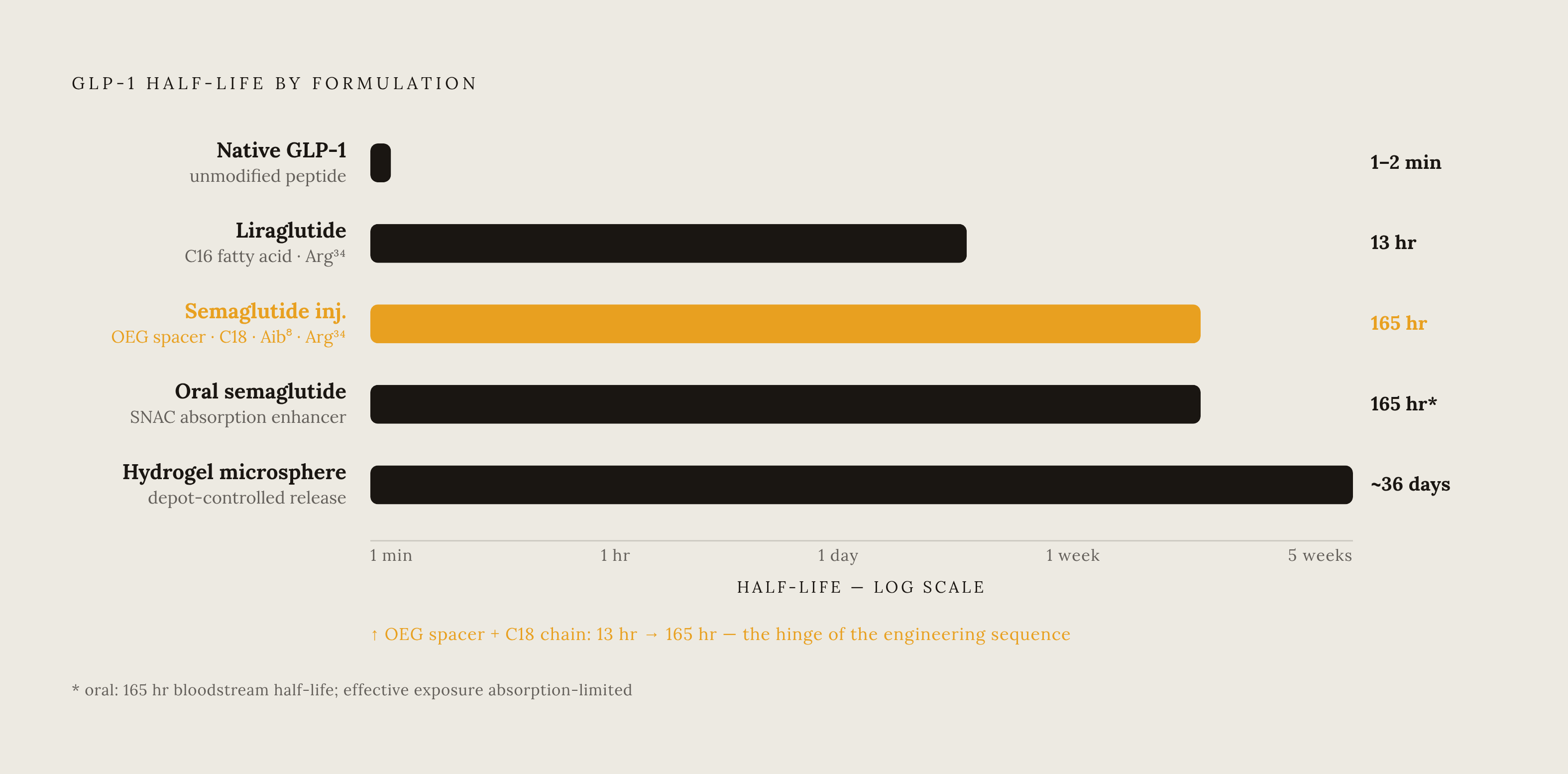
What does the clearing, specifically? Not the kidneys, and not some general metabolic breakdown. It's a single enzyme, dipeptidyl-peptidase 4, or DPP-4, which recognizes a specific vulnerable site near the N-terminus of the peptide and clips it there. Once that cut happens, the molecule loses its ability to activate the GLP-1 receptor. So the entire downstream engineering challenge, every modification discussed in this piece, traces back to one question: how do you protect that site, or otherwise keep the molecule out of DPP-4's reach long enough for it to matter therapeutically? A plasma half-life of 1–2 minutes means the hormone is cleared before it can be dosed as a drug.
The three engineering strategies that underpin every approved analog
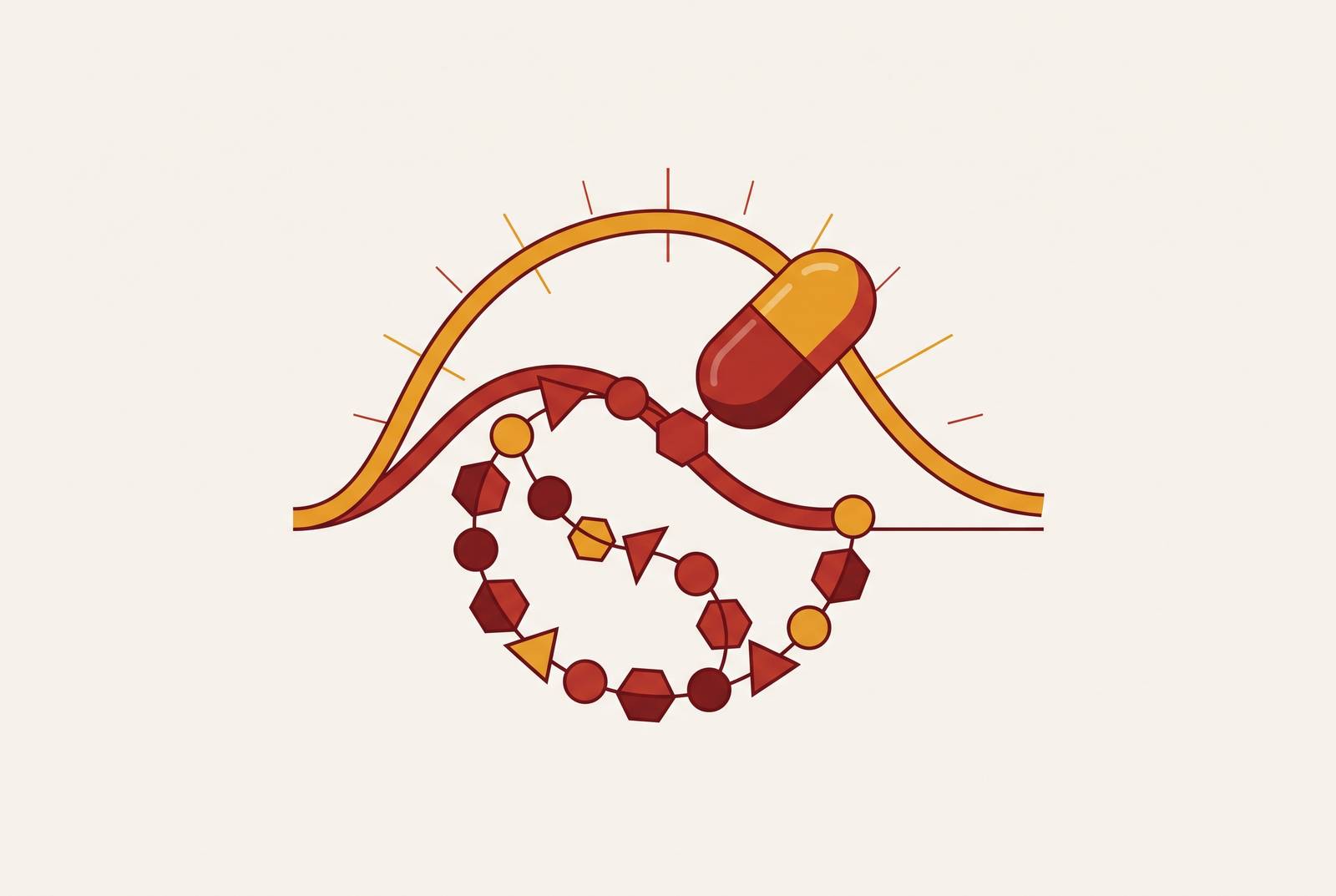
Three broad approaches have emerged to address the short half-life. The first is amino acid substitution: swap out or alter the residues sitting at the vulnerable positions, either to physically block DPP-4 from recognizing the cleavage site or to change how the molecule sits in the receptor's binding pocket. The second is fatty acid conjugation, attaching a lipid chain through a linker so the molecule binds to albumin, the most abundant protein in blood plasma, and rides along protected from both enzymatic attack and renal filtration. The third is large molecule conjugation, fusing the peptide to albumin itself or to an antibody fragment like the IgG Fc region, using sheer molecular size to dodge the kidneys and slow the whole clearance process down.
These strategies aren't exclusive of one another. The most sophisticated analogs on the market combine more than one, layering an amino acid swap on top of fatty acid conjugation to get an effect neither modification could achieve alone. Each strategy targets a distinct chokepoint in the clearance pathway, too: substitution defends the enzymatic attack site directly, lipidation exploits plasma protein binding to physically remove the drug from circulation where clearance organs can reach it, and large-molecule fusion uses size to slip past renal filtration and slow tissue distribution generally.
GLP-1 receptor agonist development has pursued three main families of modification to extend GLP-1 half-life. It's a compressed version of the same design logic every one of these six molecules had to work through in its own way.
Liraglutide: what a C16 fatty acid and a single amino acid swap accomplish
The C16 chain drives reversible binding to albumin: once bound, the liraglutide molecule moves through circulation at albumin's pace, not its own, and that sluggishness protects it from DPP-4 and from renal clearance alike. It's the same albumin logic that underlies the fatty-acid strategy generally, just executed here with a shorter chain and a simpler linker than what came later.
But 13 hours, however useful for daily dosing, isn't enough for a weekly injection. A patient missing a single dose of a once-daily drug loses coverage fast. That gap, between what a C16 chain can achieve and what a weekly dosing schedule requires, is precisely what the next molecule had to solve. Two specific modifications, S2), define liraglutide. Lys³⁴ was substituted with Arg.
Semaglutide: how extending the fatty acid chain and adding a spacer achieves a 165-hour half-life
Semaglutide starts with liraglutide's blueprint and adds a third modification.
That spacer is doing more work than its size suggests. OEG, essentially a short hydrophilic tether, pushes the fatty acid chain physically away from the peptide's backbone. Without that separation, a chain as long as C18 would likely interfere with how the molecule fits into the GLP-1 receptor binding pocket. With the separation, the longer chain can grip albumin more tightly without getting in its own way at the receptor.
The numbers bear that logic out with unusual clarity. Semaglutide binds albumin with an affinity of 0.38 nM, extremely tight, while its functional potency at the human GLP-1 receptor is 6.2 pM https://www.nature.com/articles/s41387-025-00397-4. Those two figures shouldn't, on first glance, coexist. Tight albumin binding usually comes at some cost to receptor engagement, since both events involve the same general region of the molecule. But the OEG spacer allows the molecule to have it both ways, tight albumin binding on one end and a receptor-binding pharmacophore left basically undisturbed on the other. The combined effect: a plasma half-life of 165 hours, comfortably supporting once-weekly subcutaneous dosing https://www.nature.com/articles/s41387-025-00397-4. Ala⁸ substituted with Aib (alpha-aminoisobutyric acid) confers DPP-4 resistance at the critical cleavage site. Lys³⁴ substituted with Arg (same as liraglutide).
The logic of incremental design in the liraglutide-to-semaglutide progression
Researchers studying the transition from liraglutide to semaglutide have pointed to the fatty acid moiety and its linking chemistry as the key features responsible for securing both high albumin affinity and high GLP-1 receptor potency in the newer molecule. That framing identifies where the actual innovation happened. It wasn't the amino acid substitutions that made semaglutide dramatically more durable than liraglutide.
The design sequence itself follows this logic. First, identify where the molecule is still vulnerable. Second, patch that vulnerability with the smallest disruption possible, which is what the Aib substitution does, since it's a minimal structural change that blocks the enzyme without altering the molecule's broader shape.
What that sequence reveals about the design space generally is that dosing frequency, at least within this drug class, can be tuned somewhat independently of the receptor-binding chemistry. Improve the albumin-binding mechanism and the molecule stays in circulation longer, without needing to touch the parts of the peptide responsible for actually activating the receptor. That's a meaningful degree of freedom for pharmaceutical chemists to have.
What it doesn't resolve is this. Both molecules still require a subcutaneous injection. The engineering extends how long the drug lasts once it's in the body; it does not change how the drug gets into the body. That's a separate problem, and it's the one the next two sections take up. Identify rate-limiting bottleneck (DPP-4 cleavage at Ala⁸ still relevant for liraglutide).
Pushing past weekly dosing: depot formulations and hydrogel microsphere approaches
Once-weekly is where injectable GLP-1 analogs currently top out, and the next frontier under active investigation is once-monthly dosing. One approach getting attention involves encapsulating semaglutide in hydrogel microspheres, essentially embedding the drug in a polymer matrix that releases it slowly over time rather than relying on albumin binding alone.
Half-life numbers only mean something if the drug still works at that pace, and the efficacy data from that same research shows this. A single dose of the hydrogel-bound semaglutide, given to diet-induced obese mice, produced roughly 20% lean-sparing body weight loss over the course of a month, a result the researchers described as statistically equivalent to twice-daily semaglutide dosing https://www.pnas.org/doi/10.1073/pnas.2415815121. One injection matching the effect of dozens of separate doses is the kind of result that makes a monthly-dosing future look less speculative and more like an engineering timeline.
The same microsphere platform has been applied to exenatide as well, producing a formulation with a half-life around one month and drug levels staying above the therapeutic threshold for as long as three months. That's a different kind of extension than anything fatty acid chemistry alone has produced in an approved drug so far, and it suggests depot-style formulation strategies may end up doing for dosing interval what albumin binding did for daily-to-weekly.
The oral route and small-molecule agonists: when the challenge is absorption, not half-life
Injectable dosing, however infrequent it becomes, is still a needle, and that's a real barrier for a meaningful share of patients. Oral semaglutide reached a milestone in December 2025, when it received FDA approval as a 25 mg tablet specifically for weight management, marking the first oral GLP-1 drug approved for that particular indication https://www.towardshealthcare.com/insights/glp-1-drugs-market-sizing.
Everything discussed up to this point in the piece has been about half-life once the drug is already circulating. Oral delivery is a completely different engineering problem. Once semaglutide gets absorbed into the bloodstream, its half-life is 165 hours, enabling once-weekly subcutaneous dosing. The challenge with an oral formulation is absorption itself: peptides are large, fragile molecules, and the digestive tract is specifically built to break large molecules apart before they can cross into circulation intact.
SNAC works locally in the stomach, temporarily raising the pH in the immediate area around the tablet and increasing the permeability of the stomach lining just enough for a fraction of the peptide to cross into the bloodstream before it's degraded. That's a fundamentally different kind of engineering than anything in the injectable lineage. It has nothing to do with DPP-4 resistance or albumin binding, and everything to do with getting past the gut wall in the first place.
That absorption mechanism comes with a real behavioral constraint attached. Whether that friction meaningfully affects how consistently patients take the drug is a fair question, and it's one oral GLP-1 formulations will keep facing as the category grows. Market projections suggest the oral segment is expanding faster than the injectable side of the market overall, with a compound annual growth rate of 21.8% forecast for oral GLP-1 therapies, against 12.4% for the GLP-1 receptor agonist market as a whole https://www.towardshealthcare.com/insights/glp-1-drugs-market-sizing. Injectable formulations still dominate by share, holding 69.1% of the market in 2025 against oral's 8%, but the growth curves point toward oral narrowing that gap over time https://www.towardshealthcare.com/insights/glp-1-drugs-market-sizing. SNAC (salcaprozate sodium, sodium 8-(2-hydroxybenzamido) octanoate) is an intestinal permeation enhancer co-formulated with oral semaglutide, and its role is local pH modulation and membrane permeation enhancement in the gastric mucosa. Patient-experience constraint: oral semaglutide must be taken on an empty stomach with no more than roughly 4 oz. of water, a compliance friction point that injectable analogs don't share.
Half-life engineering optimized for the bloodstream and the unreached brain
Everything covered so far treats the bloodstream as the finish line. GLP-1 receptors extend beyond the pancreas and the gut. They're expressed in the hippocampus, the frontal cortex, and the substantia nigra, brain regions tied to memory, decision-making, and motor control respectively. If the receptor machinery is present and functional in the brain, none of the engineering discussed in this piece seems built to reach it.
The clinical signals hint at what's being left on the table. GLP-1 receptor agonists have been associated with reduced seizure risk and with reduced markers of addiction across alcohol, cannabis, stimulants, and opioids, observed specifically in patients using injectable formulations. That last detail matters. If a CNS effect appears even through a delivery route that isn't optimized for the brain at all, the receptor signaling machinery there is clearly responsive to circulating drug, at least to some degree.
So why isn't more of it getting through? The exact features that make semaglutide durable in the bloodstream, its tight albumin binding and its resulting molecular bulk, are the same features that make it a poor candidate for crossing the blood-brain barrier. The barrier is selective by design, built to keep large, hydrophilic molecules like albumin-bound peptides out of the central nervous system. Engineering a molecule to survive longer in peripheral circulation and engineering a molecule to reach the brain efficiently turn out to be, in some real sense, opposing design goals.
Once inside a neuron, GLP-1 receptor activation triggers a set of signaling cascades, cAMP/PKA, PI3K/Akt, and MAPK pathways, that together support neuronal survival. The machinery is there, and it responds when reached. The bottleneck lies in delivery architecture rather than biological receptivity. It's a delivery architecture that was never built with the brain as its target.
Implications of the approved generation's engineering record for next-generation delivery
Looking across the approved generation of GLP-1 drugs, a pattern is visible once it's been named. Every major advance, from liraglutide's C16 tail to semaglutide's spacer chemistry to hydrogel microsphere depots, has optimized for one variable: how long the drug survives in peripheral circulation before clearance catches up with it. That's an entirely reasonable place to focus, given where the story started. A molecule with a two-minute half-life had to be solved before anything else about it could matter clinically.
But solving for peripheral half-life and solving for tissue-specific delivery, particularly to the central nervous system, are not the same engineering problem, and nothing in the current approved generation was really built to solve the second one. The gap between what these drugs achieve systemically and what they achieve in the brain reflects where the field pointed its effort first. It's a reflection of where the field pointed its effort first, for reasons that made complete sense given the starting point.
One might reasonably ask what a molecule engineered from the outset for brain penetration, rather than for peripheral persistence, would even need to look like. Smaller, probably. Less reliant on albumin binding as its central durability mechanism, certainly, since that mechanism is precisely what excludes it from crossing the barrier. The record left by liraglutide and semaglutide shows what focused, incremental molecular engineering can accomplish against a well-defined problem. Whatever solves CNS delivery next will have to be a comparably focused effort, aimed at a target the current generation of drugs was never built to reach. Liraglutide, a once-daily subcutaneously injectable GLP-1 analogue, has a plasma half-life of 13 hours https://www.nature.com/articles/s41387-025-00397-4. A long-acting form of semaglutide attached to hydrogel microspheres had an in vivo half-life of approximately 36 days https://www.pnas.org/doi/10.1073/pnas.2415815121. Placebo achieved weight loss of 2.4% at 72 weeks in the STEP UP trial https://www.towardshealthcare.com/insights/glp-1-drugs-market-sizing.