Alternative GLP-1 Delivery Formats Designed to Reduce Nausea
Newer delivery methods aim to flatten drug exposure and reduce treatment dropout from nausea.

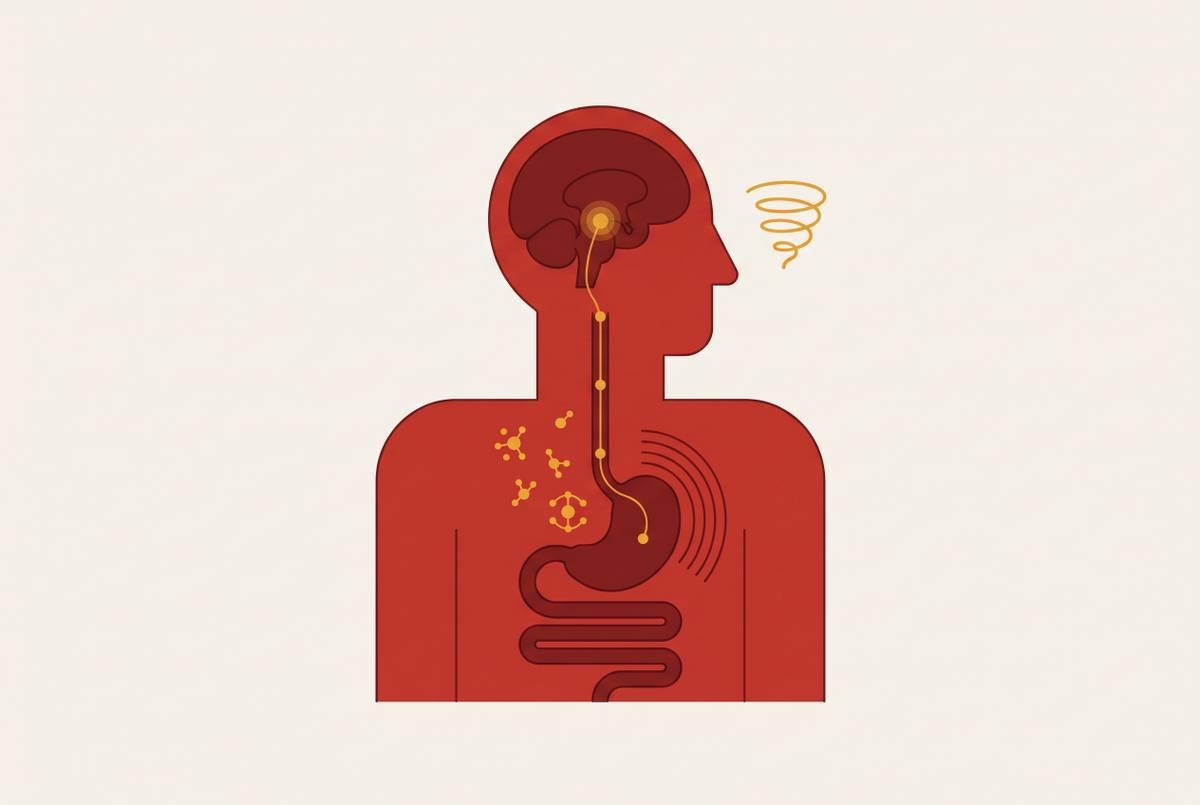
Alternative GLP-1 delivery formats aim to reduce nausea-driven treatment dropout by changing drug exposure. Oral formats make the drug easier to take, while intranasal approaches aim to reach brain receptors with less systemic exposure. Delivery design is therefore a central tolerability question, although current evidence does not establish that concentration spikes alone cause nausea or that intranasal GLP-1 will eliminate it.
Why GLP-1 nausea is not a molecule problem but a delivery problem
Nausea is common during injectable GLP-1 treatment. The delivery argument begins with a distinction between what a molecule does at its receptor and how much drug reaches different tissues over time. Injection-driven peaks in plasma concentration are a proposed contributor to transient nausea and vomiting. If those peaks contribute to symptoms, changing the exposure curve could improve tolerability without abandoning the molecule’s therapeutic action.
Dose escalation makes that distinction clinically relevant. Titration changes exposure over time while keeping the drug the same, which gives researchers a reason to study delivery kinetics. However, the use of titration does not by itself prove that receptor activation has no role in nausea. The defensible premise is narrower than that. Formats designed to flatten exposure or reach CNS receptors with lower systemic concentrations could address a source of intolerance, but their effects need to be tested directly.
Why do patients quit injectable GLP-1 therapy in the first few months?
Treatment can end before meaningful benefit accumulates. The dropout pattern described in current use includes prescriptions abandoned at the pharmacy or after the first fill, as well as discontinuation during the opening months. The Cleveland Clinic real-world study linked stopping within the first three months with very little weight loss. That link makes early persistence a clinical endpoint as well as a way to track whether patients collected their prescriptions.
Nausea is not the only barrier to persistence. Injection anxiety can discourage treatment independently of gastrointestinal symptoms, so removing a needle could help without changing the nausea profile. A Japanese propensity-matched cohort found higher adherence and persistence with oral semaglutide than with injectable semaglutide. But a European real-world study found that patients were less likely to stay on treatment with the oral format.
Could slow titration resolve the problem instead? Titration already controls treatment exposure, which gives this objection some weight. Yet its existence does not establish that nausea disappears, nor does early discontinuation establish patient impatience as the explanation. The evidence here does not show how much dropout is caused by nausea. A delivery solution must therefore demonstrate both improved tolerability and continued use.
What the GLP-1 receptor's distribution in the brain means for delivery strategy
GLP-1 receptors occur across the CNS, including the hypothalamus, hippocampus, cortex, and basal ganglia. Their presence on neurons and glial cells was identified before the first GLP-1 agent reached clinical approval. The brain is therefore not an incidental target. Receptors are active in circuits that control appetite, reward, and impulse control, which gives centrally targeted delivery a biological basis as well as the ease of avoiding injections.
Neurological findings make that rationale intriguing but unsettled. A large US Veterans Affairs observational study of millions of individuals with diabetes associated GLP-1 medications with reduced rates of Alzheimer’s disease, dementia, and substance use disorders, without establishing causation. Manolopoulos et al.’s 2025 meta-analysis of randomized controlled trials found no improvement in memory and cognition compared with placebo in Alzheimer’s disease, with low-certainty evidence.
What does this disagreement imply for delivery? It leaves open whether systemic treatment achieves the brain exposure needed for particular CNS effects, but it does not establish insufficient exposure as the explanation for negative results. Receptor anatomy identifies a destination. Intranasal delivery aims to test that destination more directly and may separate CNS exposure from the peripheral exposure needed with systemic administration.
How the nose-to-brain pathway bypasses the barriers that make injection the default
The olfactory and trigeminal neural pathways connect the nasal cavity with the CNS. They offer a route that can bypass the blood-brain barrier without requiring drug to enter the bloodstream first. Instead of relying on systemic exposure to supply the brain, a nasal formulation can seek preferential brain uptake while limiting peripheral concentrations.
Winterdahl et al.’s 2025 first-in-human PET study tested this possibility using radiolabeled oxytocin. It detected brain uptake after intranasal administration, although uptake was low and varied across participants. The finding supports nose-to-brain peptide transport in humans, but it does not show that GLP-1 reaches concentrations needed for treatment or that nausea is reduced.
A 2025 rat study moved the question closer to GLP-1 treatment by testing intranasal semaglutide with an advanced delivery technology. It reported brain-to-plasma ratios consistently greater than 1, indicating preferential CNS exposure relative to plasma. The ratio is informative but not sufficient. It does not alone establish an effective brain dose, and the study cannot resolve human tolerability. Together, these findings support investigating a route that may reduce systemic peaks.
The biological barriers intranasal GLP-1 delivery must overcome to reach the clinic
Mucociliary clearance removes foreign material from the nasal cavity, limiting the time available for absorption. Enzymes in the nasal mucosa can degrade peptides before they reach the neural pathways. Hydrophilic GLP-1 analogues also have low membrane permeability, restricting passive movement across the nasal epithelium.
These barriers act on different parts of delivery. A formulation must preserve its payload, remain at the absorption site long enough, and enable membrane crossing. The historical oral peptide experience illustrates the difficulty, with bioavailability for diabetes peptides reported at a fraction of one percent before formulation improvements. That oral baseline shows why an unprotected peptide is a demanding delivery candidate.
Can the nasal route deliver enough drug each time? Human PET uptake and preclinical brain-to-plasma ratios show that transport is possible. The route therefore depends on engineering that addresses these barriers together, followed by evidence that the resulting exposure is sufficient for its intended use.
How nanoparticle carriers and permeation engineering solve the barriers intranasal peptides face
Nanoparticle encapsulation addresses degradation by protecting the peptide payload in the nasal mucosa. Mucoadhesive formulations address clearance by extending residence time and contact with the olfactory epithelium. Permeation enhancers address the membrane barrier, helping peptides cross when correctly formulated without disrupting epithelial integrity. Protection alone is inadequate if the preserved drug is cleared before it can permeate.
The Controlled Release Society’s 2025 oral peptide workshop, reported in 2026, described how to combine methods for peptide delivery. It brought together chemical modification, including cyclization and N-methylation, formulation engineering such as nanoparticle carriers and SNAC technology, and biological permeation enhancers. The oral peptide workshop provided methodological context for intranasal GLP-1. It shows why peptide delivery often needs several methods that work together, beyond what a single protective ingredient can do.
Production introduces another test of that coordination. Nanoparticle size uniformity and manufacturing reproducibility are key dimensions of clinical translation because complex formulations must be produced consistently. A promising experimental preparation is not yet a scalable medicine. Nevertheless, the carrier architecture may provide a platform with uses beyond GLP-1, extending to other peptides and biological payloads.
Where the oral non-injectable route fits and why it does not fully solve the nausea problem
Oral GLP-1 formats offer a genuine reduction in injection burden. They remove the needle and can improve persistence in some settings, as the Japanese cohort suggests. But convenience and gastrointestinal tolerability are separate outcomes. An oral drug that relies on systemic absorption can still cause peripheral concentration peaks, even though it enters through a different tissue.
Orforglipron, a non-peptide oral GLP-1, illustrates this distinction. Its trial data show that nausea was still common, though rates were lower than the peaks seen with injections. Differences in adherence alone also cannot show whether patients kept taking the drug because of convenience, needle avoidance, or tolerability. A fair comparison separates those effects instead of treating “non-injectable” as a synonym for “less nauseating.”
Kumamoto University’s 2026 work explores another direction through a small-intestine-permeable cyclic carrier called the DNP peptide. The reported application enabled oral insulin delivery. Its relevance is intestinal transport engineering. Oral incretin approaches that access the liver through the hepatic portal route may reduce systemic exposure relative to subcutaneous delivery, but their target is metabolic. The meaningful comparison is therefore where each route delivers drug.
What the current state of intranasal GLP-1 programs tells us about how close this is to clinical reality
Intranasal GLP-1 development remains preclinical or early-translational. The human peptide imaging evidence provides a foundation, while animal work specific to this class of receptor agonists investigates whether formulations can achieve preferential CNS exposure. Evidence of transport in humans with one peptide cannot substitute for a human GLP-1 study measuring exposure, tolerability, and therapeutic effects.
MetP Pharma’s preclinical work, conducted in 2025 and announced in January 2026, framed nasal delivery as an opportunity for CNS-focused GLP-1 therapy. That emphasis distinguishes its rationale from metabolic-only applications. Landmark Medicines Ltd., a UK pharmaceutical development company, announced on September 29, 2026, plans to advance its proprietary nasal delivery platform toward a human volunteer study, selecting GLP-1 receptor agonists as the initial application. The announcement is the closest step toward clinical testing among the programs described here.
Toralgen’s program belongs to a different route. The US biotechnology company presented preclinical data on nanoparticle-enabled oral delivery of semaglutide and tirzepatide, reporting higher bioavailability than competing oral formulations. That work illustrates the application of nanoparticle engineering across GLP-1 delivery formats, but it is not evidence for intranasal delivery. For nasal programs, manufacturing reproducibility remains a translational bottleneck, while clinical studies must still establish whether targeted exposure produces the intended benefits.
Why delivery format will determine which GLP-1 programs achieve durable patient use
A treatment’s potency has limited value when patients abandon it before benefit develops. Designing GLP-1 treatment that patients can stay on therefore calls for choosing both the molecule and the delivery format. The formats need to be compared for tolerability, persistence, and how well they reach the intended receptor network. No single measure answers all three questions, and the mixed findings on oral persistence show why ease of use alone cannot be assumed to keep patients on treatment.
If concentration spikes caused by injections play a large part in nausea, formats designed to smooth those peaks or avoid high peripheral exposure should offer a way to reduce it. That possibility does not establish that all nausea is eliminable through delivery design. Intranasal programs must show that lower systemic exposure can coexist with adequate CNS delivery and acceptable tolerability in humans.
A needle-free format that reaches the brain while limiting peripheral exposure could address several limitations at once, but it has not yet established that combination clinically. Manufacturing and regulatory work must proceed with that clinical evaluation. The next chapter of GLP-1 therapeutics will depend on whether delivery engineering can turn receptor access into treatment patients can sustain.