Accelerated Stability Testing Protocols for Peptide Drug Products
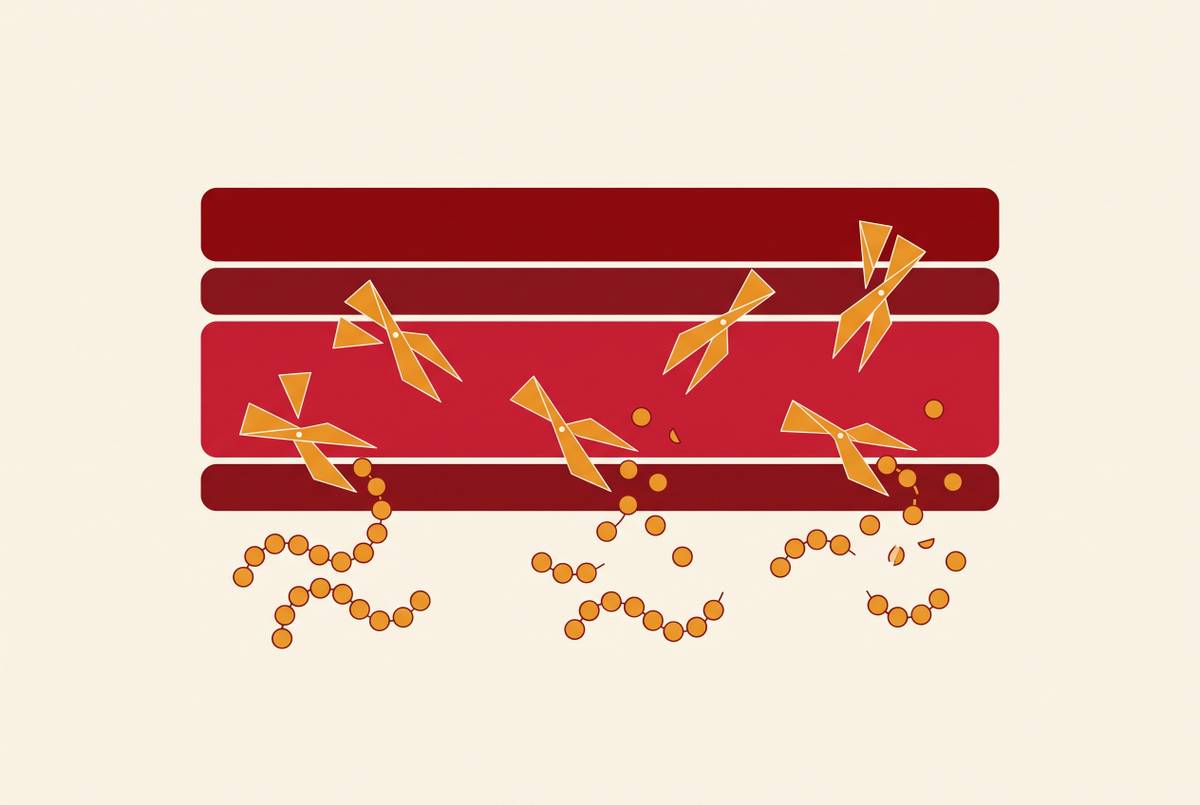
A map of four chemical degradation pathways guides stability study design for peptides.

Peptide drug products fail stability studies for reasons that are chemically specific, not vaguely biological. A peptide degrades because a particular bond breaks, a particular residue oxidizes, or a particular sequence folds into something it shouldn't, and each of those failure modes points to a different accelerated condition, a different analytical method, and a different shelf-life argument. This piece walks through that chain: from the four degradation pathways that define peptide chemistry, through forced-degradation design, condition selection, analytical endpoints, kinetic modeling, and the regulatory shifts landing in 2025 and 2026 that change what a submission actually needs to contain.
Peptides sit in an odd spot structurally. They're more chemically intricate than small molecules, carrying multiple reactive side chains and sequence-dependent liabilities, but they mostly lack the tertiary folding that gives many proteins a built-in stabilizing scaffold. This middle-ground position matters because it means peptides don't inherit either category's playbook cleanly. A stability program built for aspirin will miss the charge-variant tracking a peptide needs. A program built for a monoclonal antibody may spend resources monitoring secondary-structure loss that barely applies to a 20-residue chain. Peptides and proteins together now make up something like a quarter of the global pharmaceutical market, with sales making up a substantial share of it according to that same analysis, so getting this wrong is a serious cost. It's a commercial exposure with a dollar figure attached.
The four chemical degradation pathways that define peptide vulnerability
Every peptide stability protocol should trace back to one of four failure modes. Not a general instability. A specific, predictable, sequence-dependent map of where the molecule breaks.
Deamidation comes first, and it's often the fastest clock running. Asparagine residues spontaneously convert to aspartate or isoaspartate, and this happens especially fast at asparagine-glycine sequences where the backbone geometry favors it. The rate depends on pH, temperature, and the surrounding sequence, which is why thermal and pH stress get built into forced-degradation design from the start rather than added later. Swapping an amide for a carboxylic acid changes the molecule's isoelectric point, producing degradation products that appear as charge variants, so resolving them requires isoelectric focusing methods like iCEF or cIEF, or LC-MS/MS when finer resolution is needed. A related intermediate, aspartimide (a cyclic succinimide), forms along the way and matters enough that regulators are paying attention to it, though the 2025 ICH Q1 draft, still in public consultation and not yet finalized, doesn't name it as a fixed endpoint.
Oxidation targets methionine and cysteine almost exclusively, with tryptophan joining in under light exposure. The triggers are mundane: dissolved oxygen in solution, peroxide contamination from excipients like polysorbates, and light. That's why an oxidative challenge using hydrogen peroxide, alongside an ICH Q1B photostability study, is close to mandatory for any sequence carrying methionine. It's close to mandatory. The oxidized variants often show up cleanly on RP-HPLC with mass confirmation, but an oxidized peptide can retain partial potency, so purity data alone won't tell the full story. Potency assays have to run alongside it.
Hydrolysis and N-terminal truncation come from acid or base-catalyzed cleavage of the peptide backbone itself. Certain backbone bonds are particularly labile under acidic conditions, and truncated fragments that result can be pharmacologically dead weight or, worse, immunogenic. Acid and base stress studies are standard components of forced degradation for exactly this reason, though the pH range and exposure time should be tuned to whatever labile bonds the sequence is known to carry, not applied as a blanket recipe. Related substances get monitored by RP-HPLC, but pinning down the exact cleavage site usually takes high-resolution LC-MS/MS.
Then there's the physical side: aggregation, fibrillization, and precipitation. These aren't chemical degradation in the strict sense, but they're frequently downstream of it. A peptide that's partially deamidated or oxidized often has altered surface hydrophobicity, and that altered surface aggregates more readily than the intact parent molecule. Aggregates span a wide size range, from soluble oligomers invisible to the eye up through visible particulates, and no single analytical method covers that whole span. Fibrillization deserves particular attention for amyloidogenic sequences, a real concern for peptides carrying aggregation-prone sequences. Agitation stress and freeze-thaw cycling are strongly indicated for this reason, and SEC-MALS is a well-suited aggregation endpoint for capturing the full size range of species that may form.
Framed together, these four pathways aren't a taxonomy to memorize. They're a decision tree. Each one demands a matching stress condition and a matching analytical method, and the protocol itself should emerge directly from the chemistry rather than get bolted on from a template.
Forced-Degradation Studies as Protocol Maps
Forced degradation exists to attack a molecule from every angle it might realistically fail: heat, oxidation, acid, base, light, and mechanical stress through agitation or freeze-thaw. Conditions can run aggressive, humidity at 75% RH or above, a wide pH sweep, hydrogen peroxide challenge, UV and visible light exposure, heat paired with agitation. None of this is meant to mimic a warehouse shelf. Forcing failure fast enough reveals the shape of it.
Three things a forced-degradation study has to deliver, and none of them are optional. First, a degradation pathway map: which stress produces which product, and at what rate, which becomes the foundation for choosing accelerated conditions later. Second, proof that the analytical method can actually do its job: it resolves each degradant from the parent molecule and from every other degradant, tying directly into ICH Q2 and Q14 expectations for method validation. Third, input for the control strategy: which impurities need a hard specification, which just need monitoring, and at what stability timepoints each applies.
The FDA's synthetic peptide guidance from 2021 draws a sharp, numeric line: any new impurity has to stay at or below 0.5% of drug substance. That single threshold connects the forced-degradation data directly to the specification a developer eventually files.
Forced degradation isn't a pass or fail gate. A molecule that falls apart quickly under aggressive stress can still make a perfectly stable commercial product, provided the storage conditions are tightly controlled and whatever degradants form are pharmacologically benign. The study informs the program. It doesn't disqualify a candidate on its own. And forced degradation has a habit of surfacing problems that live in the formulation rather than the peptide itself, peroxide contamination from a polysorbate, or pH-driven hydrolysis that stays hidden until someone deliberately pushes the system hard enough to expose it.
Selecting accelerated conditions: what the degradation map tells you about temperature, humidity, and storage zone
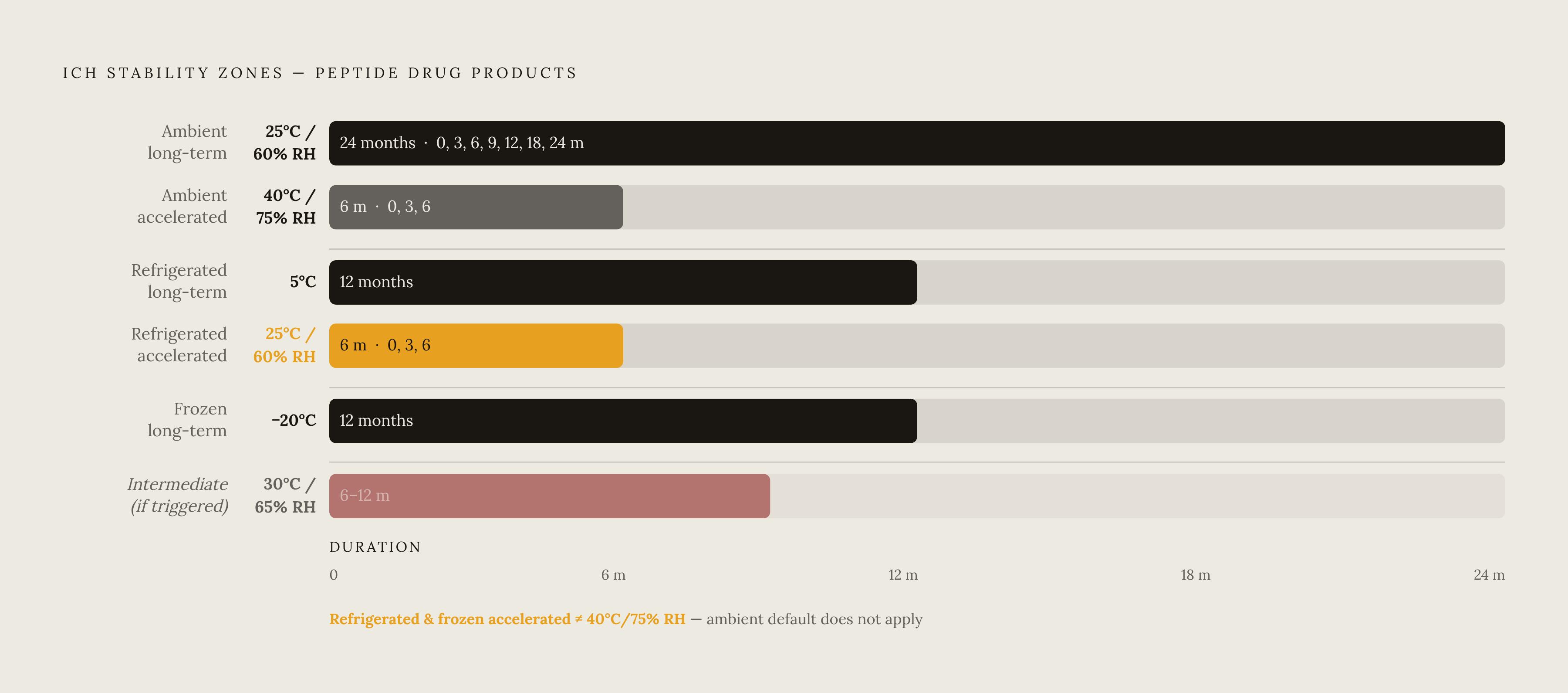
The standard ICH accelerated condition, 40°C plus or minus 2°C at 75% plus or minus 5% RH for six months, was built with ambient-storage products in mind. A lot of peptide drug products are stored refrigerated or frozen rather than at ambient temperature. They're refrigerated or frozen, and running an ambient accelerated protocol on a cold-chain product can generate degradation that has nothing to do with how the product actually behaves in the real world.
ICH guidance maps out storage zones by product type, and the differences matter. Ambient long-term runs at 25°C plus or minus 2°C and 60% plus or minus 5% RH for a minimum of 12 months at submission, with timepoints at 0, 3, 6, 9, 12, 18, and 24 months and annually after that through the proposed shelf life. Ambient accelerated is 40°C and 75% RH for six months, checked at 0, 3, and 6 months. Refrigerated products get long-term testing at 5°C plus or minus 3°C for 12 months, and their accelerated condition drops to 25°C and 60% RH for six months, since pushing a cold-chain peptide to 40°C would likely trigger degradation modes the product never sees in practice. Frozen products run long-term at negative 20°C plus or minus 5°C for 12 months, same timepoint schedule as the others.
An intermediate condition, 30°C plus or minus 2°C and 65% plus or minus 5% RH for 6 to 12 months, kicks in specifically when accelerated testing shows significant change. An intermediate condition, 30°C plus or minus 2°C and 65% plus or minus 5% RH for 6 to 12 months, kicks in specifically when accelerated testing shows significant change, and at that point it becomes the bridge that connects short-term accelerated data to a credible long-term prediction.
None of this selection process is mechanical, though. A peptide known to aggregate at elevated temperature needs agitation and freeze-thaw cycling written into the formal protocol, not treated as a side experiment. A photolabile sequence needs ICH Q1B photostability testing from day one, not added after a stability failure raises a flag. And the degradation map built during forced-degradation work tells a developer which stress is actually rate-limiting. If oxidation is driving the degradation and temperature barely moves the oxidation rate, cranking up the accelerated temperature further doesn't produce more useful data. It just produces misleading data faster. Container closure choice loops back into all of this too: a moisture-permeable closure turns humidity into a primary stress variable that needs testing, and an oxygen-permeable closure means headspace oxygen becomes a study parameter, not just something decided during formulation.
Analytical endpoints that must accompany an ICH-aligned peptide stability study
Every ICH Q1-aligned stability timepoint needs a baseline analytical panel: visual appearance, checking color, clarity, and particulates; assay for potency, usually RP-HPLC with UV detection; purity and related substances, again largely RP-HPLC, which catches truncation products, deamidation variants, and oxidation products in one run; and moisture content by Karl Fischer titration or an equivalent method, which matters a great deal for lyophilized peptide products.
Beyond that baseline sits the panel that actually separates a peptide program from a small-molecule one. SEC or SEC-MALS tracks aggregation and oligomerization, and it's close to mandatory for any peptide with known aggregation tendencies. SEC alone gives a separation but not a molecular weight for the aggregate species; adding MALS supplies that missing dimension. LC-MS/MS confirms molecular mass and identifies low-level degradation products, including sequencing out exactly where a truncation happened, and it becomes necessary whenever RP-HPLC can't cleanly separate co-eluting degradants. iCEF or cIEF handles charge-variant profiling, the method of choice for catching deamidation products since they shift isoelectric point, and it picks up aspartimide intermediates too. Circular dichroism or FTIR monitors secondary structure, relevant specifically for peptides carrying defined helical or beta-sheet content, where a structural shift often shows up before potency drops.
The 2025 consolidated ICH Q1 revision addresses class-specific degradation concerns, and oxidation and aggregation are among the endpoints that analytical methods need to be validated against. And Europe adds its own layer on top: the EMA's synthetic peptide guideline, adopted in December 2025 and taking effect June 1, 2026, requires characterization and control of residual trifluoroacetic acid, a counterion left over from common synthesis routes. TFA residue raises both toxicity and stability concerns, and its presence is treated as a regulatory red flag under the new EMA framework.
Method validation is inseparable from the choice of endpoints itself. It's inseparable from the choice itself. A stability-indicating method has to prove it can detect a defined change in the molecule of interest against the noise of everything else present, and that proof is what turns a chromatography run into evidence a regulator will accept. Every additional endpoint adds cost and complexity to a study, and the degradation pathway map from forced degradation is the tool that lets a developer prioritize sensibly, running the right method at the right timepoint rather than everything at every timepoint. But leaving out an endpoint that turns out to be relevant is a deficiency a filed study can't fix after the fact.
Kinetic modeling and ASAP: compressing years of data into weeks without losing predictive accuracy
Standard ICH long-term stability testing runs 12 to 36 months, establishing shelf life through direct, patient observation over time. That timeline works fine for a final submission package. It works terribly for early development, where formulation teams need to compare candidates and clinical timelines are already tight.
ASAP, the Accelerated Stability Assessment Program, pairs elevated temperature and humidity stress with kinetic modeling to predict real-world degradation rates from data collected over a matter of weeks rather than years. The goal is to front-load the predictive signal so decisions get made earlier and with better information. It's front-loading the predictive signal so decisions get made earlier and with better information. A 2026 review in the Journal of Applied Pharmaceutical Science, authored by Furtado, Krishnamurthy, and Abraham, found that ASAP showed strong agreement with real-time stability data across small molecules, peptides, proteins, and parenterals, and that it supported both faster formulation optimization and quicker paths to regulatory submission.
The therapeutic peptide SAR441255 is worth walking through in detail. Developers ran chemical degradation analysis across multiple formulations and multiple primary packaging materials under accelerated stress, then used kinetic modeling to project long-term stability for the intended storage condition, two years at 5°C plus a 28-day allowance at 30°C. That prediction became a genuine go or no-go input for the decision to move the molecule into clinical development, and when the predicted numbers were checked against the actual long-term analytical data collected later, the accuracy held up well. The real value here is that the answer arrived in weeks, on a question that would otherwise have sat unresolved for years while long-term data slowly accumulated. It's that the answer arrived in weeks, on a question that would otherwise have sat unresolved for years while long-term data slowly accumulated.
A separate 2025 study out of Sandoz Development Center Slovenia, led by Pavčnik and colleagues and published in Pharmaceutics, looked at ASAP specifically for parenteral drug products, with a focus on shelf-life determination and degradation kinetics. That's directly relevant to peptides, since most peptide drug products are dosed parenterally.
None of this is a free lunch, though, and the limits deserve equal weight. ASAP predictions are only as good as the kinetic model they depend on, and if degradation follows non-Arrhenius behavior, which physical degradation like aggregation often does, an Arrhenius-based extrapolation will simply be wrong. Regulators, for their part, don't accept ASAP output as a substitute for long-term stability data at registration. It's a development tool and a decision-making tool, not a shortcut around the filing requirement. And the predicted-versus-real-time match has to be demonstrated case by case. ASAP earns trust through comparison, not through assumption. Given that roughly 40% of developmental peptide candidates fail during clinical trials specifically due to instability issues, the value of catching that failure early, before the clinical investment, rather than after, is hard to overstate.
The 2025-2026 Regulatory Consolidation and Its Submission Requirements
The regulatory ground under peptide stability programs is shifting on two fronts at once, and both fronts land in roughly the same eighteen-month window. ICH's Q1 revision, still moving through public consultation as of the 2025 draft, is notable for its attention to class-specific degradation endpoints that stability-indicating methods must be validated to catch. That's a meaningful departure from treating peptides as a subset of either small molecules or biologics with a few extra tests bolted on. It's an acknowledgment, baked into the guideline text itself, that peptides carry a distinct degradation signature.
The EMA's move runs on a separate but overlapping track. Its synthetic peptide guideline, adopted in December 2025 and taking effect June 1, 2026, introduces a Europe-specific requirement around residual TFA characterization and control, tied to genuine toxicity and stability concerns tied to that counterion. For any developer running a global program, that means the stability package heading to the EMA can't be identical to the one heading to the FDA. The core degradation chemistry, deamidation, oxidation, hydrolysis, aggregation, doesn't change by geography. But the specific analytical proof a regulator wants attached to that chemistry now does.
The same principle runs through both the science and the regulation: every stress condition, every analytical method, every kinetic model has to trace back to a specific, named failure mode in the molecule. Q1's explicit endpoints and the EMA's TFA requirement aren't new burdens layered on top of good stability science. They're formal recognition of what the degradation chemistry already demanded. A developer who built a protocol around the four pathways, deamidation, oxidation, hydrolysis, aggregation, from the start will find the 2025-2026 changes look less like new hurdles and more like a regulatory system catching up to where the chemistry always pointed.
Sources
- Stability Testing of Pharmaceutical Products: Predictive Modeling, Accelerated Studies, and Applications in Novel Drug Delivery Systems - Sharon Furtado, Shwetha Krishnamurthy, Sindhu Abraham, 2026
- Accelerated Predictive Stability Testing: Accelerating Registration Phase and Application of Reduced Designs for Shelf-Life Determination of Parenteral Drug Product
- Peptide Stability Testing - Ensure Accuracy & Reliability
- Biopharmaceutical Product Stability Considerations, Part 1
- biopharminternational.com
- pmc.ncbi.nlm.nih.gov
- database.ich.org
- link.springer.com